
When budgeting for the marble flooring, most homeowners look strictly at the base square foot price of the stone at a stockyard, whether it is Katni Beige or Makrana white marble. However, the slab price typically represents only 70% to 80% of your final expenditure. To avoid mid-project budget overruns, you must account for material wastage, chemical adhesives, grouting, and multi-sage diamond polishing.
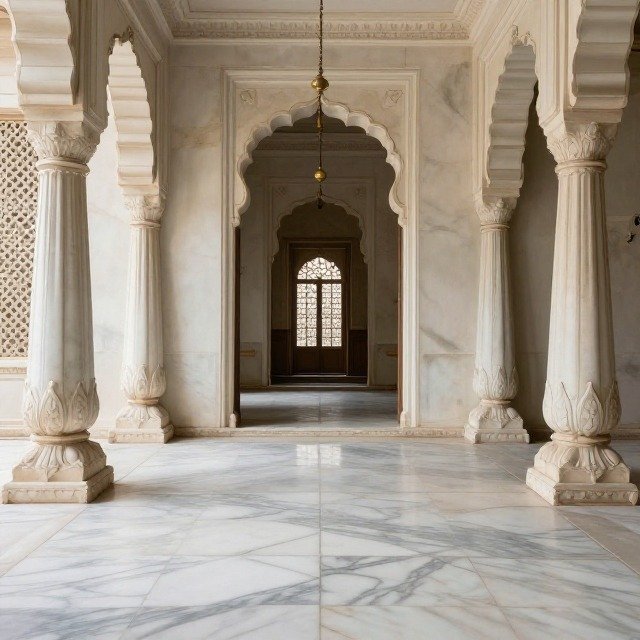
1. Material Wastage (10% to 20%)
Unlike uniform vitrified tiles, Indian marble slabs come in irregular sizes, feature natural fissures, and require strategic cutting to match veins.
- Standard Rectangles & Squares: Expect 10% to 12% wastage for large, open living areas with minimal corners.
- Complex Layouts & Vein Matching: If you are aligning dramatic veins across rooms or laying marble in diagonal patterns, staircases, and narrow corridors, wastage rises to 15% to 20%.
- Pro Tip: Always order 15% extra material from the exact same lot. Sourcing matching veins later is nearly impossible due to natural quarry variations.
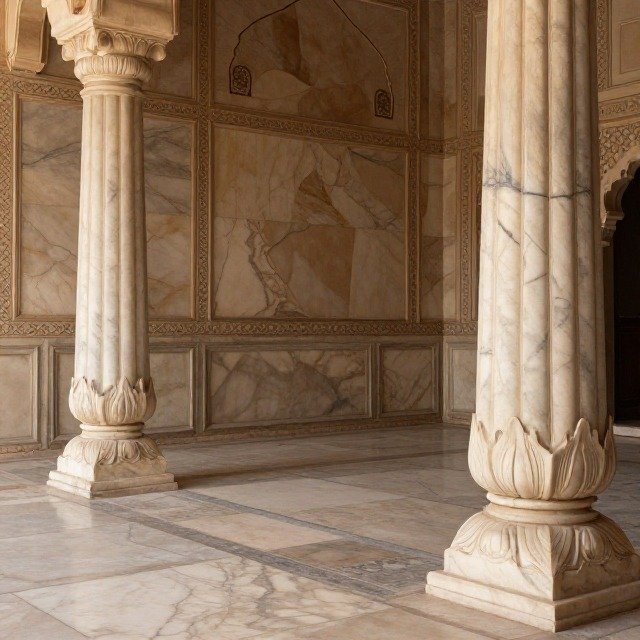
2. Bedding Mortar and Adhesives (₹35 – ₹65 per sq. ft.)
Indian marble is heavy and porous in nature, requiring a solid, level bed to prevent hollow spots and future cracking.
- Traditional Cement-Sand Mortar: A 1:4 ratio of cement and river sand (or M-sand) costs roughly ₹35 to ₹45 per sq. ft.
- White Cement & Polymer Adhesives: For translucent white marbles like Makrana or Morwad, grey cement can bleed through and stain the stone over time. Using white cement slurry or polymer-modified tile/stone adhesives adds ₹15 to ₹20 per sq. ft. to your material bill.
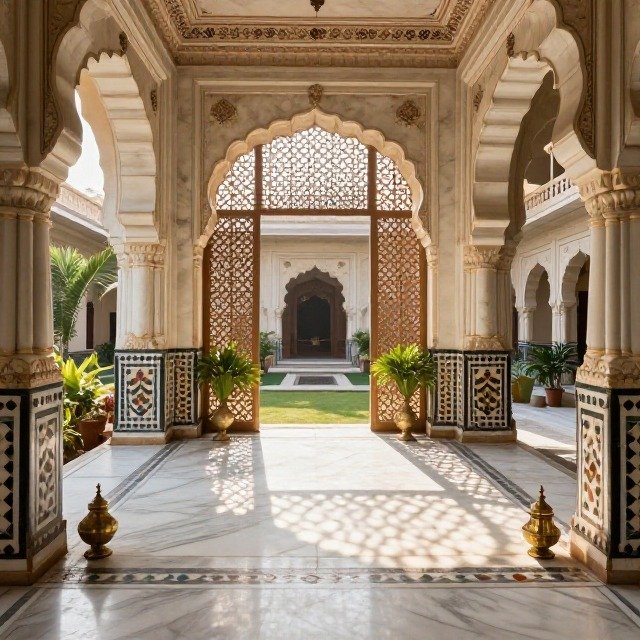
3. Grouting and Epoxy Filling (₹15 – ₹40 per sq. ft.)
Natural marble slabs have microscopic pinholes and natural cracks that must be filled before polishing to achieve a seamless, mirror-like finish.
- Standard Cement Grout: Costs around ₹15 to ₹20 per sq. ft. While economical, it can stain easily over time.
- Color-Matched Resin & Epoxy: For premium finishes, applicators mix pigment with clear epoxy or polyester resin to fill joints and natural veins invisibly. This costs ₹25 to ₹40 per sq. ft. depending on the density of veins in the slab.
4. Skilled Laying and Polishing Labor (₹70–₹130 per sq. ft.)
Marble installation is a two-phase process requiring specialized craftsmen, not general masons.
- Cutting & Laying Charges: Ranges from ₹40 to ₹70 per sq. ft. Intricate inlay work, border pattis, or staircase bullnosing will be billed separately per running foot.
- Diamond Grinding & Mirror Polishing: Once laid, the floor undergoes 7 to 8 stages of grinding using progressively finer diamond pads (from 60-grit up to 3000-grit), followed by tin-oxide or Italian crystallization. Expect to pay ₹30 to ₹60 per sq. ft. for polishing.
Complete Cost Breakdown Summary (Per Sq. Ft.)
| Cost Component | Budget Range (₹ / sq. ft.) | Premium / White Marble (₹ / sq. ft.) |
| Base Indian Marble Slab | ₹70 – ₹120 | ₹150 – ₹350+ |
| Wastage Allowance (12% – 18%) | ₹10 – ₹20 | ₹25 – ₹60 |
| Bedding Material (Sand/Cement/Adhesive) | ₹35 – ₹45 | ₹50 – ₹65 |
| Grouting & Epoxy Resin | ₹15 – ₹20 | ₹25 – ₹40 |
| Laying & Grinding/Polishing Labor | ₹70 – ₹90 | ₹100 – ₹130 |
| Estimated Total Installed Cost | ₹200 – ₹295 / sq. ft. | ₹350 – ₹645+ / sq. ft. |
(Note: Transportation, unloading charges, and skirting work are typically billed separately based on site location.)
Conclusion
Calculating the true cost of Indian marble flooring requires looking well beyond the showroom price tag. By factoring in a realistic 15% wastage buffer, opting for white cement on lighter stones, and budgeting for multi-stage diamond polishing, you ensure a flawless, generation-lasting floor without unexpected financial surprises. Always lock in a turnkey rate—or clearly separate laying and polishing quotes with your contractor before the first slab is unloaded at your site.
Frequently Asked Questions (FAQs)
1. Why is white cement mandatory for laying white Indian marble? Grey cement contains iron oxide and dark pigments. Because natural marble is porous, moisture from the mortar bed carries these dark pigments upward, causing permanent grey or yellow stains on white varieties like Makrana and Rajnagar marble.
2. How much extra marble should I buy for a 1,000 sq. ft. house? For a 1,000 sq. ft. area, purchase between 1,120 and 1,150 sq. ft. of marble. This 12% to 15% buffer covers edge trimming, corner cuts, breakage during transit, and vein alignment.
3. Is epoxy grouting better than regular cement grouting for marble? Yes. Epoxy and color-matched resins do not shrink, crack, or absorb dirt and moisture. Once ground down during the polishing phase, epoxy-filled joints blend seamlessly with the natural stone, creating a monolithic look.
4. How long does the entire marble laying and polishing process take? For a standard 1,000 to 1,200 sq. ft. home, laying takes about 7 to 10 days. After a mandatory curing period of 10 to 14 days to let the mortar dry completely, grinding and polishing take another 4 to 5 days.

