
While choosing Indian white marble for commercial and residential projects, Ambaji White and Morwar White marbles are most preferred, as they represent the most popular mid-tier natural stone in the market. These two marbles are quarried in western India, and they are offered at affordable prices, such as Carrara, and they display noticeable differences in mineral composition, durability, and affordable price.
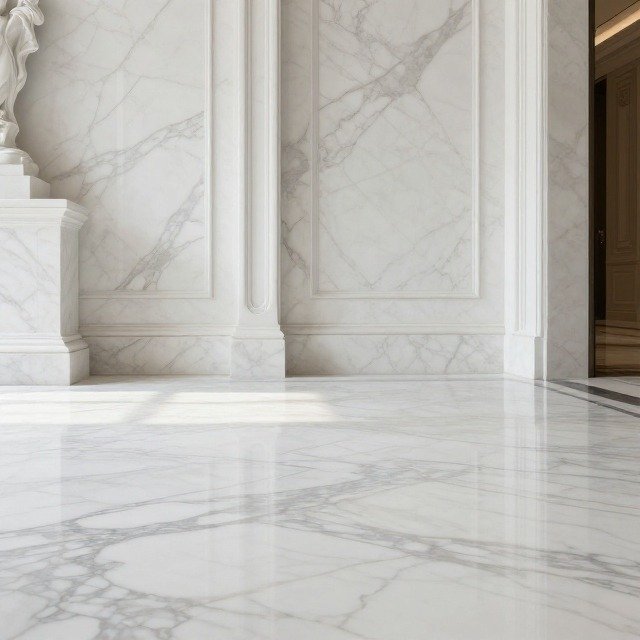
Origin and Visual Characteristics
- Ambaji White Marble: It is quarried from the region of Gujarat and Rajasthan, and this stone is prized for its milky white background and extremely fine grain. It exhibits minimal to subtle, soft grey clouds and lends a calm uniform appearance across expansive floor plates.
- Morwad White Marble: It is sourced from the Rajsamand district of Rajasthan. Morwad white features a bright off-white background patterned with distinct grey, black, or brownish swirls on the surface. It is a coarser crystalline structure, and it has good contrast in its vein pattern.
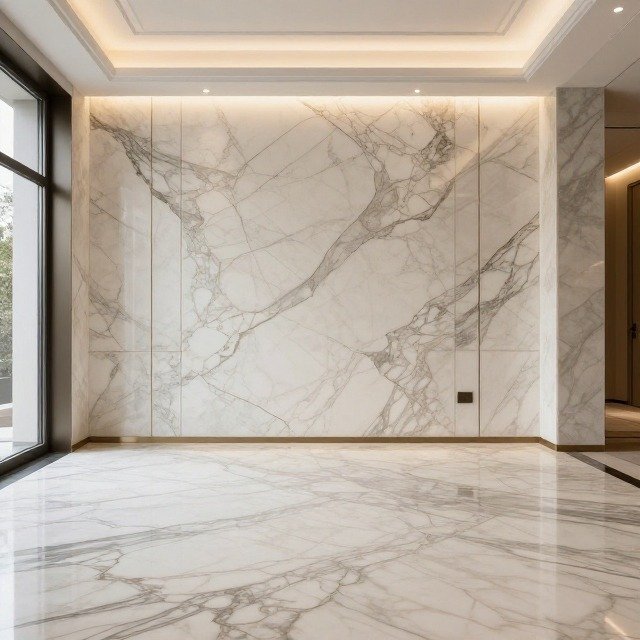
Head-to-Head Comparison: Consistency, Durability, and Cost
| Feature | Ambaji White Marble | Morwad White Marble |
| Primary Origin | Ambaji / Banaskantha (Gujarat border) | Morwad, Rajsamand (Rajasthan) |
| Visual Texture | Milky white, fine-grained, subtle clouds | Bright white base with bold grey veining |
| Lot Consistency | High: Minimal shade variation across slabs | Moderate: High variation from slab to slab |
| Pattern Matching | Easy; suitable for seamless, quiet layouts | Requires bookmatching or deliberate sorting |
| Density & Porosity | Dense calcium carbonate matrix; low porosity | Moderate density; requires thorough sealing |
| Typical Price (per sq. ft.) | ₹70 – ₹200 (standard to premium grades) | ₹40 – ₹140 (economy to select grades) |
| Best Suited For | Large contiguous flooring, temples, quiet luxury | Feature floors, budget homes, accent walls |
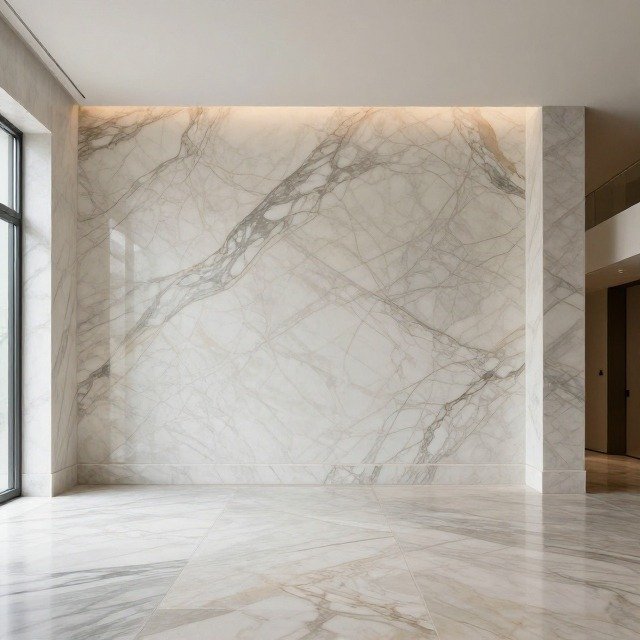
Evaluating Consistency: Which Stone Performs Better?
Ambaji White wins decisively on consistency.
Due to its uniform crystalline texture and low concentration of volatile mineral intrusions, Ambaji White yields larger batches with predictable coloration. Especially, for homeowners or architects who want seamless floors without jarring vein discontinuities, Ambaji White allows masons to lay large expanses with minimal sorting waste.
Morwad White, conversely, varies widely from block to block. While high-grade Morwad can mimic Carrara marble with flowing grey veins, lower-grade slabs frequently present unpredictable pinholes, patchy grey clouds, or directional bands. Dry-laying and careful lot inspection are mandatory when installing Morwad to prevent abrupt pattern breaks.
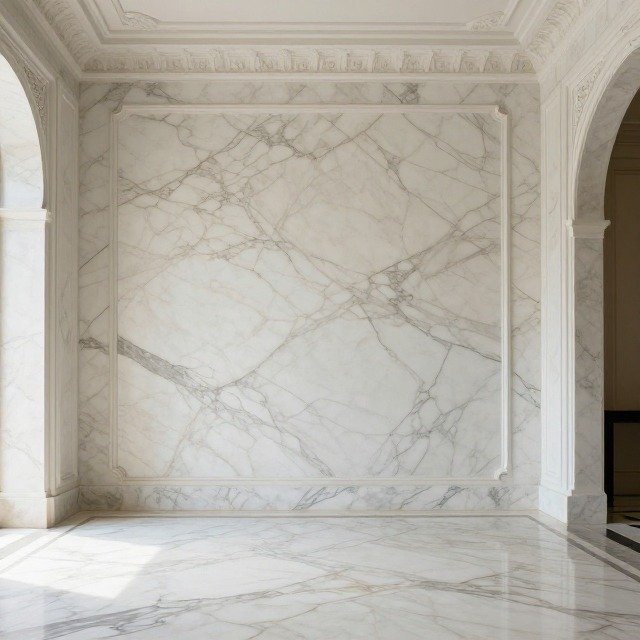
Evaluating Value: Price vs. Total Lifecycle Cost
Morwad White offers superior upfront affordability, while Ambaji White provides greater long-term durability value.
- Upfront Budget (Morwad Advantage): If project capital is the primary constraint, Morwad White is nearly 30% to 50% cost effective per square foot compared to Ambaji. For rental properties, commercial halls, or mid-budget home interiors, it delivers an authentic white marble aesthetic at a fraction of the cost.
- Maintenance & Longevity (Ambaji Advantage): Ambaji White has a high structural density and superior calcium purity, and that makes it less prone to hairline fissures, surface pitting, and localized discoloration over time. While Morwad requires diligent periodic sealing to stop moisture and oil absorption, Ambaji takes a brilliant high polish that holds its gloss longer in high-traffic zones.
The choice comes down to architectural intent: choose Morwad White if you want dynamic veining and maximum square-footage coverage on a strict budget; choose Ambaji White if you prioritize lot uniformity, minimal maintenance overhead, and a serene, temple-grade milky white finish.
Frequently Asked Questions
Does Ambaji white marble turn yellow over time?
Ambaji White has a high calcium purity (often exceeding 98–99%) and very low iron oxidation rates compared to many other Indian stones. Provided it is laid with white cement (rather than grey Portland cement) and sealed with a breathable impregnating sealer, it will not turn yellow.
Can Morwad White marble be bookmatched?
Yes. Morwad White slabs often feature flowing, high-contrast grey veining that responds very well to bookmatching. When paired correctly, it creates striking symmetry for living room feature panels and main entrance foyers.
Which of the two is better for mandirs and prayer spaces?
Ambaji White is the standard choice for Hindu temples and home mandirs. Its visual purity, lack of aggressive veining, and fine grain make it ideal for fine carvings, murtis, and traditional architectural jaali work.

