
In this modern architectural era, there are many elements that add texture, and then these elements can transform the space into a gallery. Bookmatching is an intricate and beautiful technique of arranging the marble slabs in mirrored style. For millennia, nature has written stories in the swirling vein patterns and dark, deep shades and shimmering minerals of granite, marble, and other natural stones.
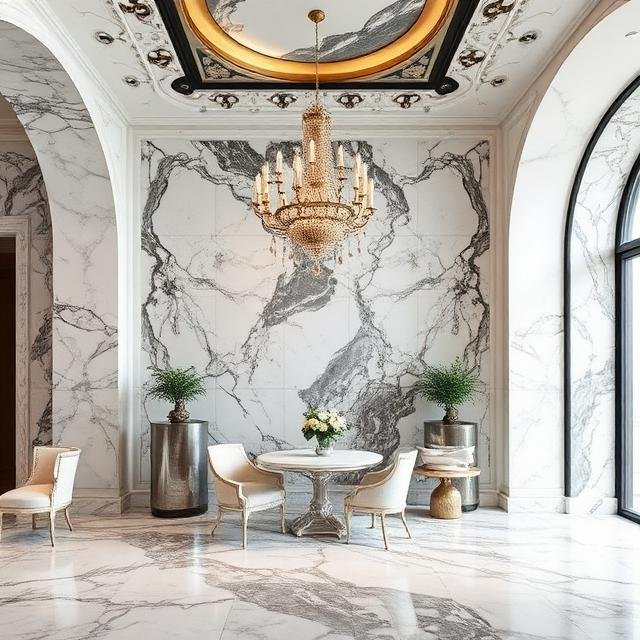
Bookmatching is an art of reading those stories and reciting them multiple times to create a stunning symmetrical effect, like a butterfly-like masterpiece on the wall. It is the architectural equivalent of flawlessly executing precision, durability, and natural beauty. In this comprehensive guide we will delve into the design considerations, application techniques, and how to use the bookmatching technique to create an iconic symmetrical featured wall design.
The Anatomy of a Symmetry: What is Bookmatching?
Bookmatching is a fabrication technique. Imagine taking a thick block of marble and cutting it into slabs just like a loaf of bread. Instead of stacking the slabs in their original sequence, bookmatching flips every slab just like opening the pages of a book. It creates a mirrored image where the veining pattern of marble can radiate from a central spine.
This technique is most dramatic and successful with natural stone that has strong, directional veining, dramatic patterns, and dramatic shades. Marbles like Breccia Capraia, Statuario, or Carrara marble are exotic marbles with a finely polished texture that are suitable for bookmatching, as the resulting symmetry is often too subtle to appreciate.
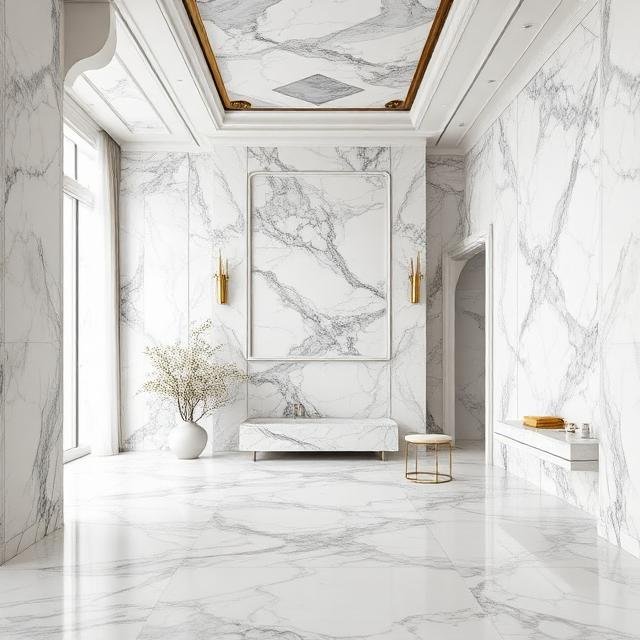
Design: The Blueprint for a Showstopper
A bookmatched feature wall is not an impulse addition; it’s a design decision that needs space, purpose, and a thoughtful layout. Here’s how to plan for one:
1. The “Where” and the “Why”: Context is Everything
Where do you place a bookmatched wall? The answer is simple: anywhere you want to create a jaw-dropping focal point. But context is crucial.
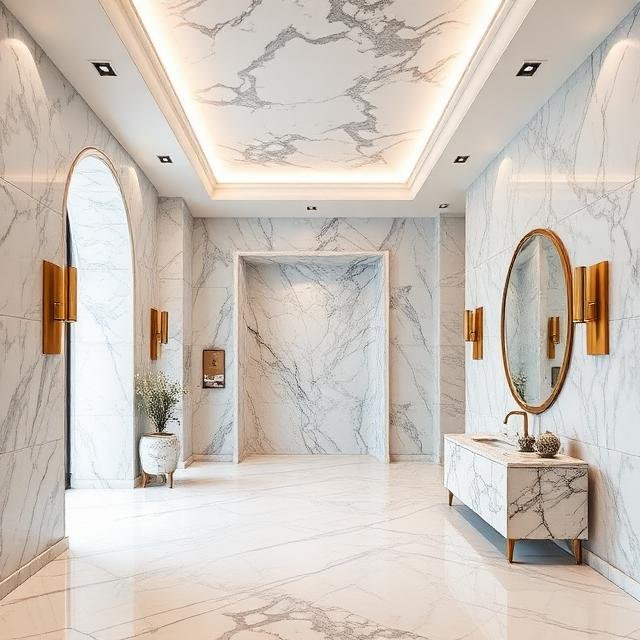
- Residential Grandeur: In the premium high-end living room, the floor-to-ceiling bookmatched wall behind a modern sofa creates a masterpiece statement. In a master bath, it elevates a shower or a vanity wall into a spa-like sanctuary. In a formal entryway, it sets a tone of sophisticated luxury.
- Commercial Elegance: From the lobbies of five-star hotels to the boardrooms of MNCs, bookmatching adds a layer of corporate gravitas and artistic design. It can be used as a concierge desk, an executive office wall, or even an entire restaurant feature wall.
2. Choosing the Canvas: Selecting the Right Stone
This is, by far, the most critical step. You’re not just buying stone; you’re selecting an art piece.
- Visualize the Result: When choosing a marble slab, don’t just look at the individual masterpiece. Work with your marble supplier and fabricator to see digital mockups or physical samples of how the two slabs will look when bookmatched. Usually a single slab can look chaotic, but its bookmatched pair can reveal a hidden, dramatic symmetry.
- Embrace Imperfection: No two slabs are identical, and even in a bookmatched pair, there will be slight variations. This is part of the charm. It shows that the symmetry is natural, not manufactured.
- The Power of Pairings: Often, you think to pair multiple slabs to create a complete wall. You plan how the center lines of each pair of slabs will connect. Are you thinking of a continuous pattern? Or are you planning to create a segmented artwork? The connections between the bookmatched pairs are precise craftsmanship and artistic expression.
3. Composition: The Art of the Reveal
How the slabs are composed on the wall matters as much as the slabs themselves.
- Vertical or horizontal? Most bookmatching is done vertically; it creates a rising butterfly effect, while the horizontal bookmatch can be equally stunning, especially for a wider area like a long fireplace mantle.
- Framing and Edging: How do you finish the edges? You might frame it with subtle metal trim or a wooden piece for a more seamlessly integrated look. You can consider using the same stone on adjacent surfaces to create a textural field from which the artwork emerges.
Fabrication: Precision Is Non-Negotiable
Once the design is set, the baton is passed to the fabricator. This is where art meets engineering.
1. Sourcing and Sequence: The Foundation
- Consecutive Slabs: You must source the sequential slabs, and these slabs are cut from the exact block of stone and ensure the veining pattern is continuous and can be mirrored easily.
- Handling with Care: The slabs are usually very large and delicate. It must be handled with care during transportation and cutting the slabs to prevent cracking and breakage. Especially during the polished faces that will be bookmatched.
2. Cutting and Polishing: The Mirrored Edge
This is the most critical technical step.
- The Perfect Cut: The two adjacent edges of the bookmatched slabs must be cut with laser-like precision. This is often done using advanced CNC machines to ensure the cut is perfectly straight and that the veining patterns align seamlessly at the center. A difference of even a millimeter can throw off the symmetry.
- Joint Preparation: The edges must be “jointed”—or polished to get a perfect design, often a 45-degree angle—so that when they are joined, the resulting seam is as invisible as possible, making the two slabs appear as one continuous surface.
3. Layup and Inspection: The Moment of Truth
- The Dry Lay: Before installation, the fabricator must do a “dry lay.” They lay the finished, bookmatched slabs out on the workshop floor, exactly as they will be installed. It allows the fabricator and the designer to inspect the alignment of the veins, the tightness of the seam, and the overall symmetry. This is the moment to catch any imperfections.
Installation: The Final Act
The installation of a large bookmatched wall is a high-stakes, multi-person job.
1. Wall Preparation: A Perfect Surface
- Flatness is Key: The substrate (the wall the stone will be attached to) must be perfectly flat and structural to support the immense weight of the stone. Any imperfections in the wall will be magnified by the stone, especially at the critical center seam.
- Moisture Barriers: In wet areas like bathrooms, a robust moisture-proofing system, i.e., sealant, must be applied behind the stone.
2. Adhesives and Support: Holding Up Art
- Epoxy Systems: Most bookmatched walls are installed using high-strength epoxy adhesive systems. This creates a permanent, structural bond.
- Mechanical Supports: For very tall or heavy walls, mechanical anchors (like small L-brackets hidden in the joints) may be used to provide additional support.
3. The Center Seam: The Disappearing Act
This is the make-or-break moment.
- Meticulous Alignment: The installation team carefully aligns the first slab, then positions the second, pressing its mitered edge against the first with extreme precision. They use specialized clamps, suction cups, and shims to ensure the veining patterns line up perfectly.
- Seam Filling: Once in place, the seam is filled with a color-matched epoxy. After it cures, it is polished by hand to the same high sheen as the rest of the wall, making the seam virtually disappear. This is the hallmark of professional bookmatching.
The Conclusion: The Butterfly Emerges
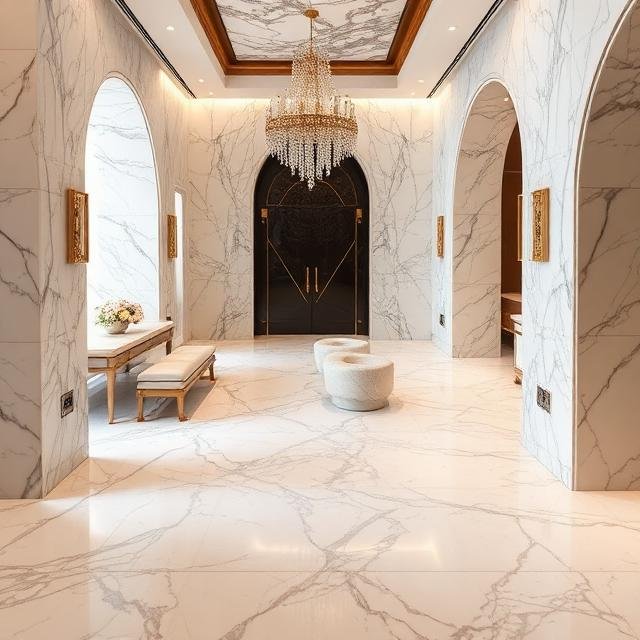
The result is, without fail, breathtaking. The wall is no longer a surface; it’s a statement. It’s a conversation piece. It is natural art, curated and presented with human ingenuity.
Bookmatching is a testament to the enduring appeal of natural stone and the boundless creativity of architectural design. It reminds us that sometimes, the most stunning art is not created by a paintbrush, but by the patient, powerful forces of the earth, brought into perfect, symmetrical focus by human hands.
FAQs (Frequently Asked Questions)
1. Can you bookmatch any kind of stone?
While the technique can theoretically be used with any stone, it’s not always desirable or effective. Bookmatching works best with stones that have strong, directional veining, dramatic patterns, or rich color gradients. The most popular choices are marbles (like Calacatta, Statuario, Breccia Capraia), granites (like Titanium or exotic Brazil granites), and some quartzites (like Taj Mahal). It is generally not recommended for subtle, fine-grained, or uniformly colored stones (like polished Absolute Black granite) as the resulting symmetry is too subtle and the prominent seam becomes a distraction.
2. How much more material does bookmatching require?
This is a key consideration. To create a bookmatched wall, you need at least two (and often more) sequential slabs. Depending on the size of the wall and the desired layout, this can mean using up to 50-100% more material than a standard, “random” lay-up. You also have to factor in more waste from trimming edges to create the perfect joints. The most efficient projects often use the “drops” (the extra material) for other applications like countertops, backsplashes, or even small furniture pieces.
3. How visible will the center seam be?
In a high-quality, professional installation, the center seam should be virtually invisible. This is achieved through three key factors:
- Precision Fabrication: The adjacent edges are cut perfectly straight and jointed (often mitered) so they fit together tightly.
- Meticulous Installation: The installers use specialized tools and techniques to align the two slabs so the veining pattern is seamless.
- Color-Matched Filler: The seam is filled with a matching epoxy, then polished by hand to the same high sheen as the rest of the wall, making it disappear. If you can clearly see the seam from more than a few feet away, it is a sign of poor quality.
4. Is bookmatching a modern or traditional technique?
It’s actually both. Bookmatching is an ancient technique that has been used for centuries in some of the world’s most grand and sacred architecture, from Italian cathedrals to Indian palaces. It speaks to a long-standing human fascination with symmetry and the raw beauty of natural materials. In recent years, it has found a natural home in modern and minimalist design, where its clean, symmetrical patterns are used as a form of powerful, “living art.”
5. What’s the main difference between bookmatching and “slip-matching”?
- Bookmatching: Slabs are flipped like the pages of a book, creating a mirrored image and a strong central symmetry.
- Slip-matching: Slabs are laid out in sequence, without being flipped, much like how they were cut from the block. The veining pattern continues, but there is no central symmetry. This creates a more organic, continuous flow across a larger area.

