
During planning for interior designing for commercial and residential spaces, the natural stone remains the ultimate choice for sophistication, durability, and aesthetics. For centuries the Italian marble is imported from Italy, Turkey, and Spain, and it has a reputation as the pinnacle of luxury, celebrated for its dramatic veins and high gloss translucence.

However, behind showroom lighting and high price tags lies a critical geological reality: imported marble is frequently softer, more brittle, and far more porous than high-grade Indian marble.
Architects, civil engineers, and experienced stonemasons frequently expressed that Indian marble is the superior material for structural integrity, load-bearing flooring, and multi-generational durability.
1. Geological Formation & Crystalline Density
Marble is a metamorphic rock formed when limestone is subjected to high heat and tectonic pressure. The mineral composition and the duration and intensity of this metamorphism determine the rock’s physical resilience.
- Indian Marble (e.g., Makrana, Ambaji, Rajnagar): It is quarried primarily along the ancient Aravalli Range in Rajasthan. Indian marble originates from Precambrian to Proterozoic formations among the oldest geological terrains on Earth. The prolonged metamorphic pressure produced tightly interlocked, fine-grained calcite and dolomite crystalline structures. This compact lattice gives the stone its exceptional bulk density, compressive strength, and high resistance to chipping or fracturing.
- Imported Marble (e.g., Carrara, Botticino, Statuario): Most Mediterranean and Turkish deposits were formed during younger geological eras. They tend to feature a looser, softer crystalline structure. While this softness allows for rapid, mirror-like polishing, it leaves the stone vulnerable to structural hairline fractures and surface abrasions under everyday mechanical stress.
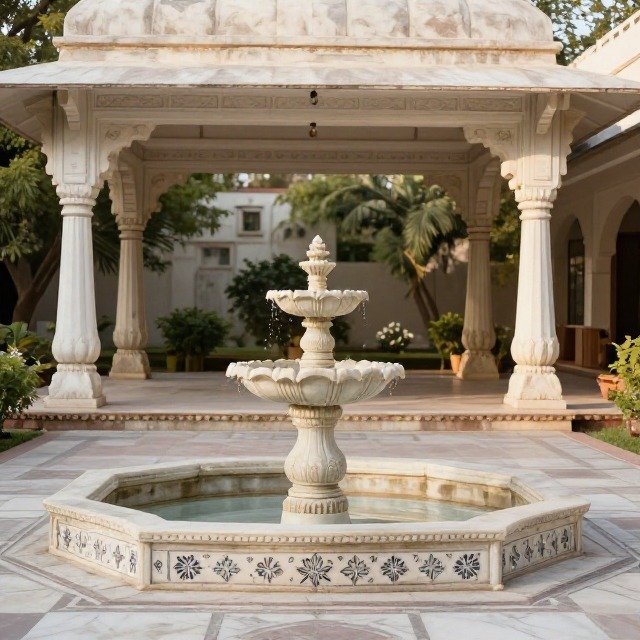
2. Standard Slab Thickness: 18–30 mm vs. 16–18 mm
A major practical factor in structural performance is the thickness at which the stone is quarried and sold:
- Indian Marble: Slabs are usually cut into the standard thicknesses of 18 mm to 20 mm, and even up to 30 mm for heavy-duty architectural steps and thresholds. This extra mass provides high flexural strength, allowing the slabs to support heavy furniture, rolling loads, and structural movement without cracking.
- Imported Marble: Due to shipping constraints, weight freight tariffs, and quarrying practices, imported marble is typically sliced thin, often 16 mm to 18 mm. Thinner, softer stone flexes poorly, making it significantly more susceptible to cracking during transport, cutting, or after installation if there is even minor substrate settling.
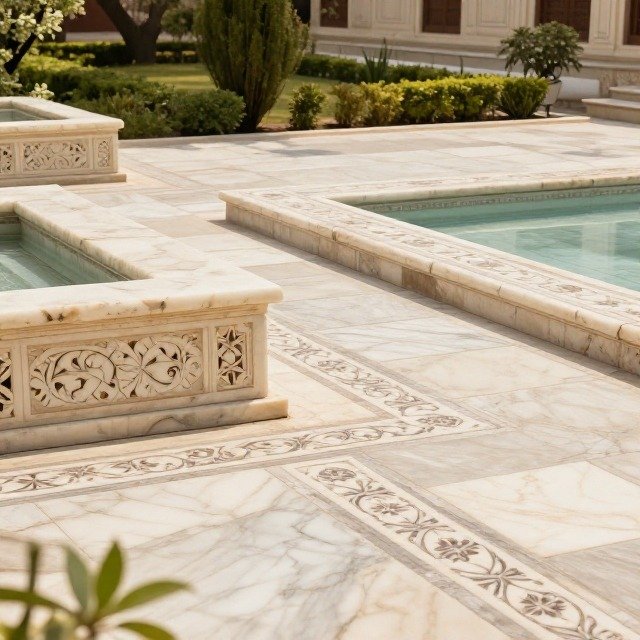
3. The Need for Epoxy Resin and Fiberglass Mesh Backing
A clear indicator of a stone’s inherent structural fragility is the processing required before it reaches the job site:
- Imported Marble Slabs almost universally arrive with a fiberglass mesh and epoxy resin backing applied at the quarry. Without this reinforcement, the slabs would fracture under their own weight during international shipping and handling. When cutting imported slabs on-site, masons must use specialized bridge saws and continuous water jets to prevent shattering along internal fissures.
- Indian marble slabs, with their dense crystalline matrix, rarely require synthetic mesh backing. They possess high tensile cohesiveness, allowing them to be transported, carved, water-cut, and dry-laid with minimal risk of structural failure.
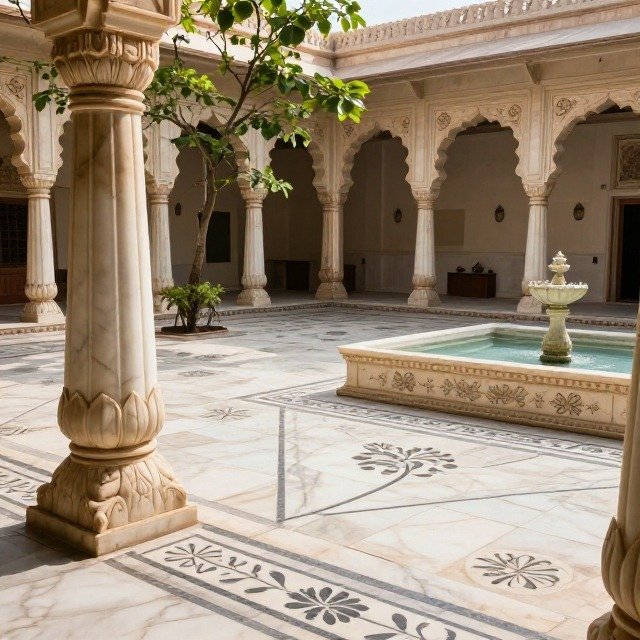
4. Porosity and Compressive Strength
Porosity directly impacts how well a stone resists moisture damage, thermal weathering, and subsurface efflorescence:
| Structural Metric | Indian Marble (e.g., Makrana / Ambaji) | Imported Marble (e.g., Carrara / Botticino) | Structural Advantage |
| Water Absorption Rate | Extremely low (~0.05% – 0.15%) | Moderate to High (~0.25% – 0.60%) | Indian: Resists internal moisture expansion & staining. |
| Mohs Hardness Scale | 3.5 to 4.5 | 3.0 to 3.5 | Indian: Noticeably more scratch & abrasion resistant. |
| Average Density | 2,700 – 2,850 kg/m³ | 2,550 – 2,700 kg/m³ | Indian: Greater mass per cubic meter. |
| Reinforcement Needed | Rarely requires mesh backing | Almost always requires epoxy mesh | Indian: Retains natural monolithic strength. |
Because imported marble absorbs moisture more readily, water trapped underneath during installation can trigger yellowing, pinholing, and internal degradation over time. Indian marble’s lower porosity prevents water infiltration, preserving its structural integrity across varying climates.
5. Historical Proof of Performance
There is no better test of structural endurance than centuries of exposure:
- The Taj Mahal (completed in 1653) was constructed using Makrana White Marble. Over 370 years later, it is exposed to scorching North Indian summers, monsoon downpours, and environmental pollution; still, the stone remains structurally sound without spalling or crumbling.
- The Victoria Memorial in Kolkata and countless ancient temples across Rajasthan and Gujarat stand as physical testaments to the longevity of indigenous marble in demanding climates.

Conclusion
While imported marble offers undeniable glamour, fluid veining, and a contemporary luxury aesthetic, its structural resilience is compromised by its lower crystalline density, thinner profiles, and higher porosity.
Indian marble is structurally superior. Its geological age, high compressive strength, superior abrasion resistance, and natural thickness make it a true permanent installation—capable of enduring heavy foot traffic and structural loads for generations without relying on synthetic resin reinforcement. For those prioritizing durability and lifecycle value, Indian marble stands as the clear engineering choice.
Frequently Asked Questions (FAQs)
Q1: Does Indian marble scratch or stain less than Italian marble?
Yes. Indian marble typically scores 3.5 to 4.5 on the Mohs hardness scale compared to Italian marble’s 3.0 to 3.5. This increased hardness makes it much more resistant to foot-traffic abrasions, dragging furniture, and daily wear. Its lower porosity also makes it less prone to deep liquid stains.
Q2: Why does imported marble always have mesh glued to the back?
Because of its softer crystalline formation and natural fissures, imported marble is inherently fragile. Quarry processors apply an epoxy resin and nylon/fiberglass net to the back of each slab to keep it from snapping during transit and fabrication. Indian marble is structurally dense enough that it rarely needs this netting.
Q3: Can Indian marble be re-polished like imported marble?
Indian marble can be ground and re-polished multiple times across decades. Because the slabs are typically 18–20 mm thick and uniform in density, heavy mechanical diamond polishing can easily refresh the stone without risking breakthrough or structural damage.
Q4: Which is better for high-traffic zones like corridors, staircases, and living areas?
Indian marble is significantly better suited for high-traffic zones. Its superior impact resistance and density prevent the dull walking paths, micro-chips, and hairline cracks that frequently appear on imported marble floors subjected to heavy traffic.

