
Choosing between large-format marble and full-size marble slabs is the most critical decision in luxury design. It is the best option for both commercial and residential architect design. While both natural stone veins showcase different vein patterns, logistical feasibility, final aesthetics, and cost.
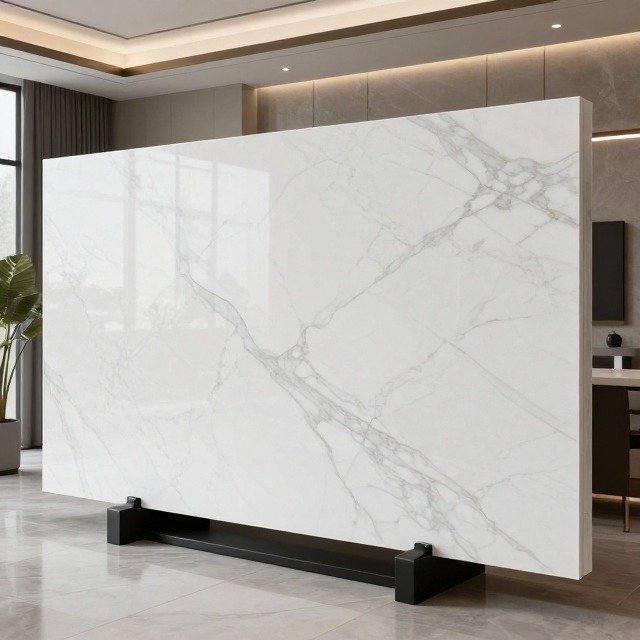
Traditional bookmatched marble slab accent wall. Source: Adila Ceramic
What Defines Each Option?
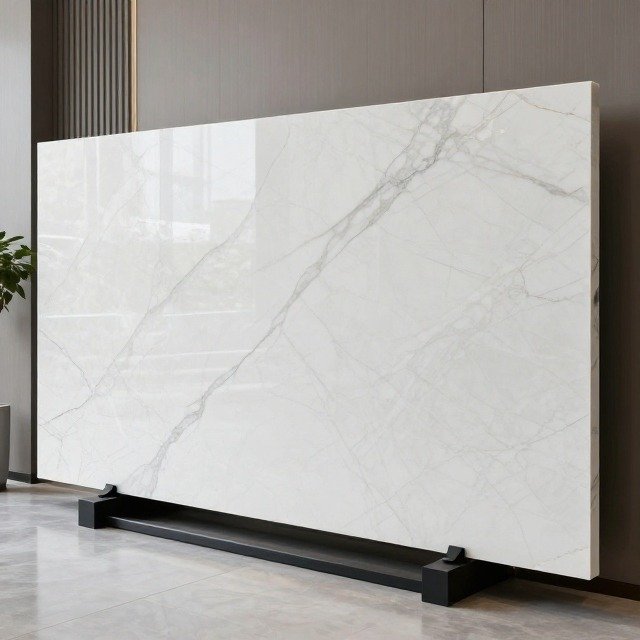
- Traditional Marble Slabs: It is quarried directly from the quarry. Each continuous panel typically measures 8 to 10 feet in length, 5 to 6 feet in width, and 18 mm to 20 mm in thickness. Marble slabs provide an unbroken expanse of veining and are the standard choice for bookmatching, waterfall counters, and grand feature walls.
- Large-Format Marble Tiles (LFM): Precision-engineered stone panels that generally measure 24×48 inches, 48×48 inches, or larger, calibrated to a uniform thickness of 10 mm to 12 mm. They offer the visual scale of slabs with the modular handling of tile.
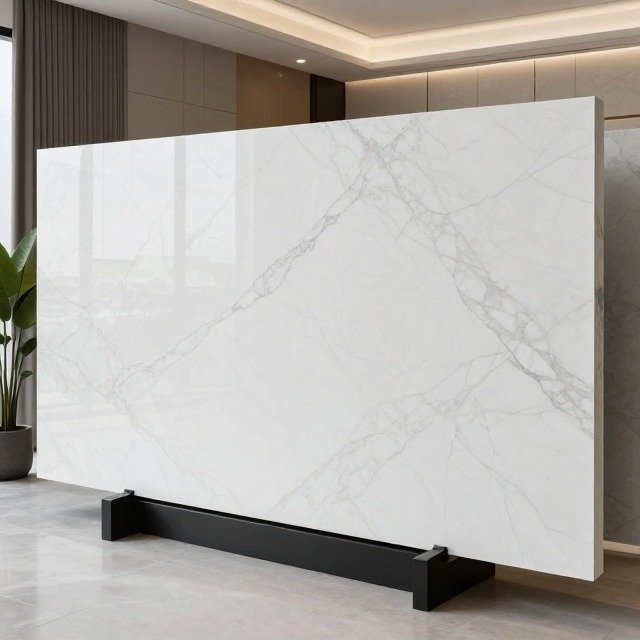
Direct Comparison: Head-to-Head
| Feature | Large-Format Marble Tiles | Traditional Marble Slabs |
| Material Thickness | 10 mm – 12 mm | 18 mm – 20 mm |
| Weight per sq. ft. | ~5.5 to 6.5 lbs | ~11 to 13 lbs |
| Grout Lines | Minimal (1/16-inch joints) | Virtually seamless / monolithic |
| Bookmatching Potential | Limited / Pre-cut patterns | Exceptional / Full block-cut veining |
| Material & Freight Cost | Moderate | High to Premium |
| Installation Complexity | Standard mechanical clip/suction | Heavy rigging, cranes, A-frames |
| Subfloor Prep Requirements | Requires strict flat tolerances (<1/8 in over 10 ft) | Structural load verification is essential. |
| Best Application | Expansive floor spans, bathrooms, high-rises | Statement walls, kitchen islands, lobbies |
Key Decision Factors
1. Aesthetics and Visual Continuity
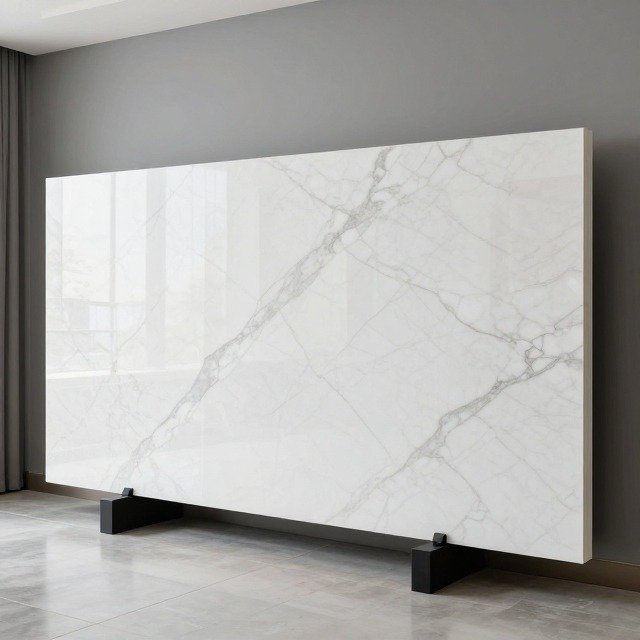
Traditional marble slabs are always unmatched when visual continuity is paramount. If your design calls for continuous grain flow across walls where veins mirror each other symmetrically, full slabs are required. Large-format tiles minimize grout lines compared to standard 12×12 inch tiles, but repetitive breaks are still visible across a wide floor.
2. Structural Load and Logistics
Weight showcases the feasibility of the stone. Slabs weigh nearly double the mass of calibrated tiles. Moving a 600-pound slab into an upper-floor penthouse or staircase often demands external crane lifts and structural floor reinforcement. Large-format tiles can be transported via standard service elevators and handled by a two-person crew using suction frames.
3. Substrate Preparation
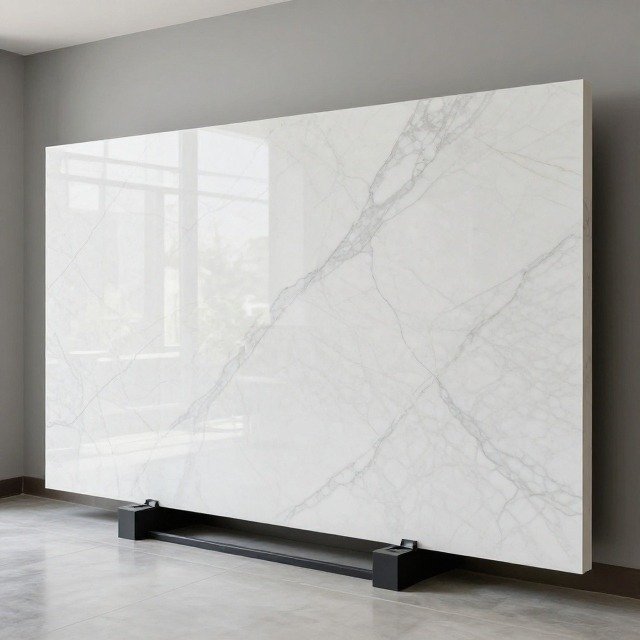
Large-format tiles have zero tolerance for substrate deflection. An uneven screed causes “lippage” and hollow spots that crack under point loads. Traditional slabs, when laid over a thick-bed mortar screed, allow experienced masons more leeway to adjust levels on-site during setting.
4. Total Cost of Ownership
Slabs carry higher acquisition, crating, transport, and labor expenses. Breakage during fabrication or cutting accounts for 15% to 25% material waste on complex slab layouts. Large-format tiles carry lower shipping rates, simpler handling equipment, and predictable modular yields.
The Verdict
For uninterrupted dramatic looks, such bathroom featured wall designs, fireplace surroundings, and kitchen islands, traditional slabs are superior. The broad floor areas, multi-storied apartments, and budget-friendly conscious renovations are an expansive stone look luxury without any logistical friction. The large-format marble tiles offer the better balance of performance, beauty, and cost-effectiveness.
Frequently Asked Questions
Can large-format marble tiles crack more easily than slabs?
Tiles are thinner, making them susceptible to cracking if installed over an uneven substrate with voids under the tile. When installed using 95%+ thin-set mortar coverage and a level substrate, their structural resilience matches standard installations.
Do large-format marble tiles require special grout?
Yes. Use high-performance, non-shrink, unsanded, or epoxy grout formulated for narrow joints (1/16 inch or 1.5 mm). Color-matching the grout to the marble’s base color creates the closest resemblance to a seamless slab.
Are full marble slabs worth the extra cost for living room floors?
Only if seamless, unjointed stone and continuous custom veining are your top aesthetic priorities. For most residential floors, large-format tiles yield 85% to 90% of the visual impact at nearly half the total installed cost.

