
If you are planning to construct or renovate your home using natural stone, then you must be perplexed about whether to use Italian marble or Indian marble for your dream home. While both offer unique features and durability. Both are undeniable elegance and timeless beauty, and their origin makes them significantly different in aesthetics, performance, and cost. Here is a comparison guide for homeowners of Italian marble vs. Indian marble with respect to durability, maintenance, veining pattern, availability, and cost.
Understanding these key variations in durability, veining, and availability is essential to making the right long-term choice for your dream home.
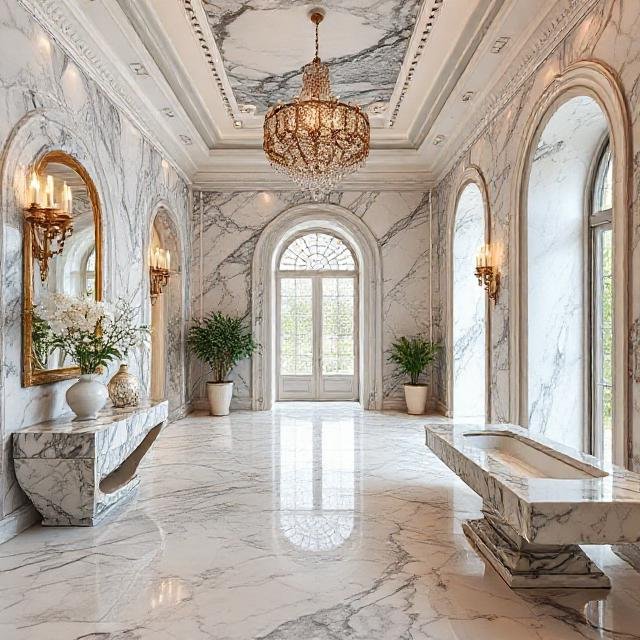
1. Durability and Maintenance
The main difference between these two natural stone is their origin, geological structure that directly impacts the porosity, maintenance and hardness of the stone.
| Feature | Italian Marble (e.g., Carrara, Statuario) | Indian Marble (e.g., Makrana, Udaipur Green) |
| Durability | Moderate. It is comparatively softer and more porous. | High. It is generally denser, harder, and less porous. |
| Hardness | Softer, making it easier to polish to a mirror-like shine, but more susceptible to scratching and etching from acids (like lemon or vinegar). | Harder, which makes it more resilient against daily wear and tear, making it ideal for high-traffic areas. |
| Porosity | Higher porosity; requires frequent sealing (often annually) to prevent deep stains. | Lower porosity; more resistant to staining and requires less frequent sealing. |
| Thickness | Typically cut into thinner slabs (18mm – 20mm), often requiring a nylon mesh reinforcement for strength. | Available in thicker slabs (18mm – 30mm) and is naturally more robust. |
| Ideal Use | Low-traffic luxury areas: Wall cladding, vanity tops, decorative tabletops, master bathroom flooring. | High-traffic, functional areas: Main flooring, kitchen countertops, staircases. |
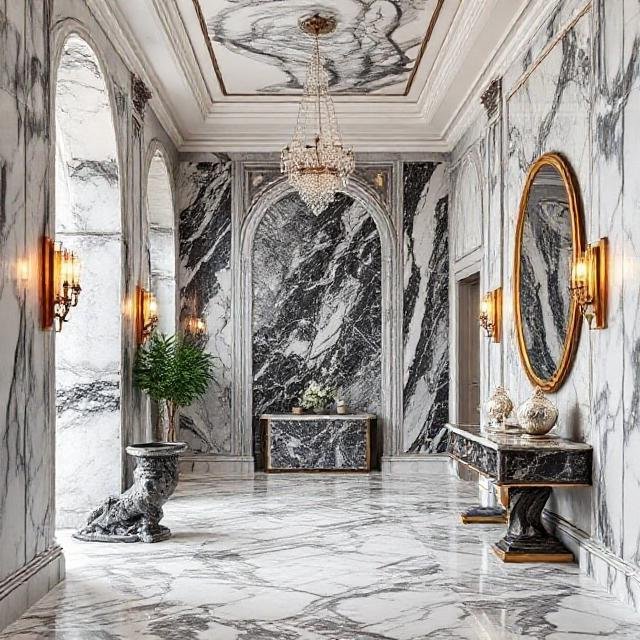
Verdict on Durability: Indian Marble is more robust and low maintenance choice for daily use especially for high traffic areas like in living room, and kitchen.
2. Veining Pattern and Aesthetic
The aesthetic appeal is what truly separates these two natural stones.
| Feature | Italian Marble | Indian Marble |
| Veining Pattern | Elegant and Dramatic. Known for soft, flowing, and artistic veining that often appears like brushstrokes. Patterns are typically subtle, yet rich. | Bold and Defined. Veins and patterns are often sharper, more geometric, and more distinct in their contrast to the base color. |
| Base Color | Predominantly favored for classic white bases (e.g., Statuario, Calacatta) or creamy beige (Botticino). | Offers a much wider spectrum of rich colors, including whites (Makrana), pinks (Jodhpur Pink), greens (Udaipur Green), and browns. |
| Lustre/Finish | Exceptionally high, crystal-like lustre and translucency, giving it a premium, luminous, and wet look. | Medium lustre; achieves a deep polish but generally has a softer, more natural glow. |
| Notable Types | Carrara (feathery grey veins), Calacatta (thick, dramatic veins, sometimes gold), Statuario (pure white base, bold grey veins). | Makrana (pristine white, used in the Taj Mahal), Ambaji White (uniform white), Rainforest Green/Brown (web-like, intricate patterns). |

Verdict on Aesthetics: Italian marble offers a classic, luxurious appeal and sophisticated look; Indian marble offers a wide range of colors and an earthy and traditional appeal.
3. Availability and Cost
Due to the origin and logistics, availability present and easy access is the biggest difference.
| Feature | Italian Marble | Indian Marble |
| Origin & Sourcing | Imported primarily from quarries in Northern Italy (Carrara, Verona). | Locally quarried within India (Rajasthan, Gujarat, Madhya Pradesh). |
| Availability | Less readily available, dependent on import cycles. Limited stock and higher lead times for specific types. | Readily available from local quarries and suppliers across the country. Easy to source replacements or custom cuts quickly. |
| Cost | Premium Price. Significantly more expensive due to import duties, transportation costs, and high-demand reputation. | Affordable/Budget-Friendly. Cost-effective due to local sourcing and lower logistical expenses. |
| Environmental Impact | Higher carbon footprint due to extensive global transport. | Lower carbon footprint as it is locally sourced and transported. |
Verdict on Cost: Indian Marble is the winner for cost-effectiveness and project budget, offering superior value for large-scale flooring.

Conclusion: Which Marble is Better?
There is no single “better” marble; the superior choice depends entirely on your budget, lifestyle, and design priority.

- Choose Italian Marble if:
- Your budget is premium and you seek unmatched, luminous elegance.
- The application is in a low-traffic area (e.g., a formal living room feature wall or master bathroom vanity).
- You are prepared for higher maintenance (sealing and polishing).
- Choose Indian Marble if:
- You need a cost-effective solution for a large area.
- The space is high-traffic (e.g., kitchen, commercial floor, busy corridor).
- You prioritize durability and low maintenance.
FAQs: Making the Right Marble Choice
Q1: Is Indian marble actually more durable than Italian marble?
A: Yes. Indian marble is generally denser and harder than Italian marble, making it more resistant to scratches and wear-and-tear in high-traffic areas.
Q2: Can I use Italian marble in my kitchen?
A: You can, but it is not ideal. Italian marble is softer and more porous, making it highly susceptible to etching (dull marks) from acidic spills (vinegar, lemon, wine) and staining from food and oils. Indian marble is a much more practical choice for kitchens.
Q3: Why is Italian marble so much more expensive?
A: The primary reasons are its imported status (high duties, shipping costs), its reputation for luxury, and the complexity of quarrying and handling the softer stone.
Q4: Which marble type is better for India’s climate?
A: Indian marble is naturally adapted to the local climate. It handles variations in temperature and moisture better than the generally softer, thinner Italian marble.

