
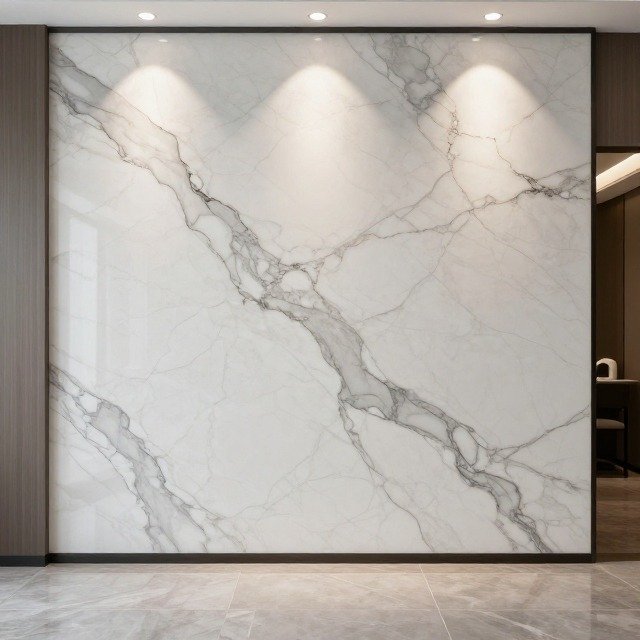
When you walk through the natural stone yard, you will feel like you are curating an exclusive gallery of geological art. The polished and honed rows of natural stone nothing captures visual attention quite like marble with beautiful vein patterns. From dark shades like charcoal black and green shades, deep violet networks of Calacatta Viola with bold veins turn the simple countertop, feature walls, and center of attraction into masterpieces.
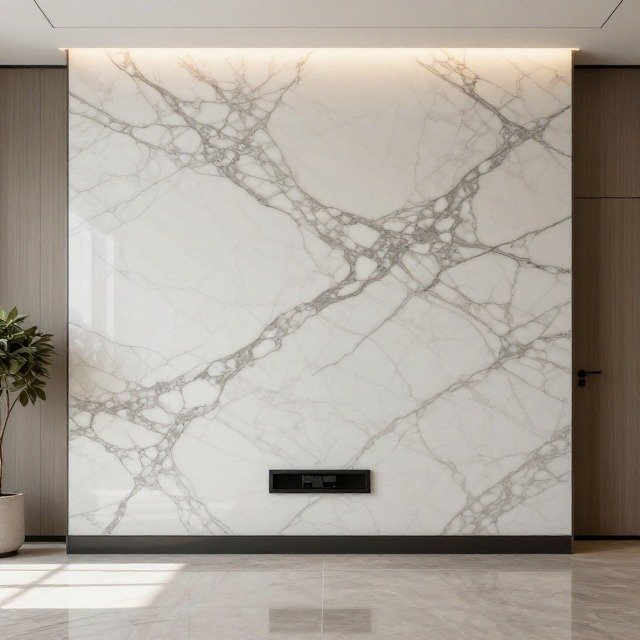
Choosing the slab requires a balance between architectural vision and technical requirements. Here is the comprehensive guide to choose the best natural stone marble from the natural stone yard and secure a perfect slab for your dream project.
1. Plan Before You Step Into the Yard
Before you head to a local supplier, you need to clarify the functional and spatial parameters of your design:
- Measure with Waste Allowances: Dramatic veining requires intentional matching across joins. Always account for 15% to 25% extra material to allow fabricators to align patterns seamlessly without running out of stone.
- Define the Focal Point: Is the stone intended for a sprawling kitchen island, a bookmatched fireplace surround, or a bathroom vanity? Larger horizontal and vertical expanses showcase bold directional patterns best, whereas smaller, broken-up surfaces can cut off statement veins abruptly.
- Bring Cabinet and Tile Samples: Marble rarely features pure, clinical white backgrounds. Undertones like warm ivory, grey, taupe, or blue-grey. Matching your paint swatches, metal finishes, and millwork samples directly against full-size slabs under natural light avoids costly mismatches.
2. Inspect Full Slabs, Not Samples
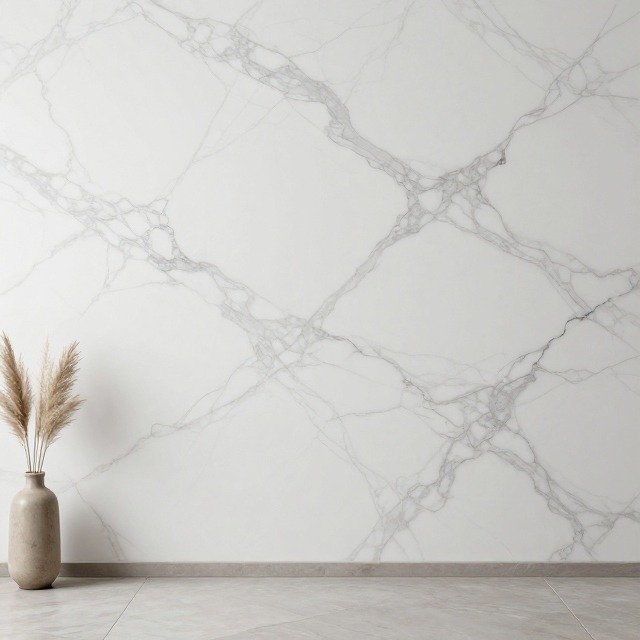
A 4×4-inch showroom swatch cannot convey the full story of dramatic marble. A single sample might capture a quiet corner of pure white or an ultra-dense vein cluster, misrepresenting the balance across an 11-foot slab.
- Ask the Yard Staff to Unrack the Bundle: Never judge slabs stacked tightly behind one another. Ask the warehouse team to unrack your top contenders using their crane so you can step back at least 8 to 10 feet to evaluate the flow and rhythm of the entire piece.
- Inspect Sequential Bundles: If your design spans multiple slabs, confirm that they originate from the same block and are sequentially cut. Marble from different blocks often exhibits contrasting colors and completely different veining velocities.
3. Understand Vein Dynamics: Bookmatch vs. Continuous Flow
Dramatic marble demands clear coordination with your stone fabricator:
| Pattern Style | Description | Ideal Applications |
| Bookmatched | Two consecutive slabs cut and polished like open pages of a book, creating a symmetrical mirror image. | Feature walls, open-concept kitchen backsplashes, shower walls, fireplace surrounds. |
| Slip-Matched / Sequential | Consecutive slabs laid end-to-end to maintain a continuous, unidirectional diagonal or linear flow. | Long galley islands, continuous perimeter runs, extended bar tops. |
| Quarter-Matched / Butterfly | Four slabs mirrored along both horizontal and vertical axes to form a central diamond kaleidoscope. | Grand entryways, hotel-style foyer flooring, and double-height feature walls. |
4. Differentiate Between Natural Fissures and Structural Cracks
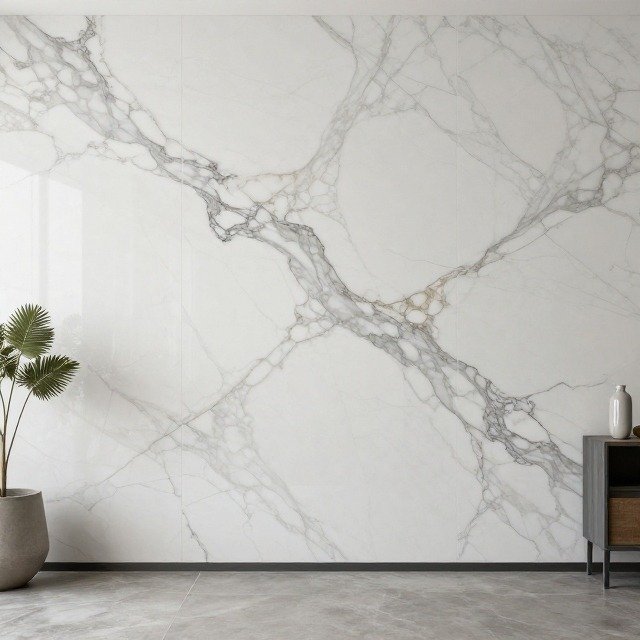
Dramatic veins are geological faults mineralized over millions of years by impurities like iron oxide and clay. Because it is formed under intense heat and pressure, they can behave differently from the surrounding calcite.
- The Fingernail Test: Run your fingernail gently across prominent veins. A natural fissure filled with calcite minerals will generally feel smooth and flush. If your fingernail catches deep in a cleft or detects an open seam, it may indicate a structural crack or resin reinforcement.
- Inspect the Back of the Slab: High-movement marbles almost always feature a mesh backing reinforced with fiberglass and epoxy resin. Check the edges and underside to confirm the mesh is bonded securely and free from delamination.
- Look for “Dry Veins”: Dry veins are porous pathways that haven’t fully mineralized. In wet zones or high-use kitchen areas, these areas can absorb moisture at a faster rate than the dense white field stone.
5. View Under Multiple Angles and Lighting Conditions
Warehouse halogen lights can wash out delicate hues and obscure surface irregularities.
- Examine the Polish or Honed Uniformity: Crouch down and view the slab at a 30-to-45-degree angle. Look for “orange peel” texture, dull spots along heavy mineral veins, or uneven resin fills.
- The Water Spray Test: If you are buying unpolished or unsealed slabs, ask the staff to mist a section with clean water. This temporarily reveals how deep and vibrant the veins will appear once sealed with an enhancing sealer or high-gloss finish.
- Evaluate Daylighting: Whenever possible, ask for the slab to be moved toward an open loading bay to see its true undertones under natural daylight.
6. Finish Selection: Honed, Polished, or Leathered?
The finish you choose directly impacts how dramatic veins read within an interior space:
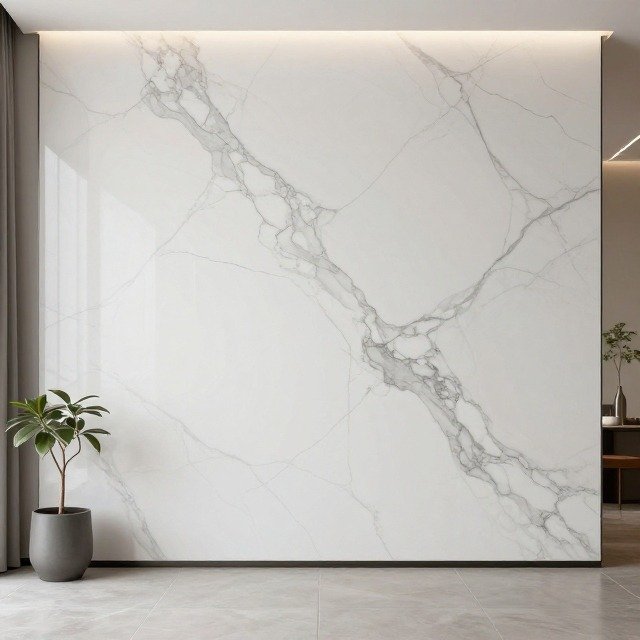
- Polished: Delivers deep contrast, crisp vein boundaries, and maximum drama. Ideal for dry feature walls and statement areas, though high reflection can sometimes create glare under direct downlights.
- Honed (Matte/Satin): Softens the contrast, providing an organic, timeless look. It conceals day-to-day etching and light micro-scratches far better than high gloss, making it a favorite for busy islands.
- Leathered / Brushed: Adds physical texture by gently eating into softer calcite while leaving harder quartz and mineral veins subtly raised. It provides an artisanal, tactile feel with minimal glare.
Summary Checklist for Stone Yard Visits
- Accurate square footage calculated with a 15–20% matching buffer.
- Physical finish samples (cabinetry paint, hardware, flooring swatches) in hand.
- Whole sequential bundle inspected in full view.
- Checked for structural cracks vs. natural mineral fissures using the fingernail test.
- Slab inspected under daylight or varied angles for surface polish consistency.
- Digital template (vein-mapping) plan confirmed with your fabricator.
Frequently Asked Questions (FAQs)
Q1: Is heavily veined marble structurally weaker than uniform marble?
In many cases, heavily veined marble contains higher variations in mineral composition across the stone. While mineralized veins are naturally cemented over geological eras, areas with heavy veining can be more brittle during transportation and fabrication. Standard modern processing utilizes epoxy resin vacuum-treatment and fiberglass mesh backing to ensure slabs meet structural requirements for residential counters and vertical cladding.
Q2: What is the difference between a natural fissure and a crack?
A fissure is a naturally occurring mineral boundary formed during the geological development of the stone; it does not compromise structural integrity when properly resin-treated. A crack is a fracture caused by physical handling, stress, quarry blasting, or transit impacts. Cracks often penetrate cleanly through the thickness of the stone and catch sharply on the surface.
Q3: How do fabricators ensure veins line up across corners and backsplashes?
Reputable fabricators use digital slab-matching software (such as Slabsmith). High-resolution digital photographs of your exact slabs are loaded into CAD software, allowing you and your designer to preview exactly where cut lines, waterfall miters, cutouts, and backsplash seams align before cutting.
Q4: Does dramatic veining show stains and scratches more easily?
Dramatic veining is actually very forgiving when it comes to minor surface etching, water spots, and dust, because the varied organic patterning visually breaks up the background. However, porous mineral veins may require careful sealing to prevent selective absorption of oils or dark liquids along the vein lines.

