
Bookmatching represents one of the most sophisticated fabrication techniques in luxury architecture and interior design. It originated from stonemasonry, bookmatching pairs of consecutive slabs sliced from the same Italian marble block, and polishing adjacent so that their veins mirror each other like an open book.
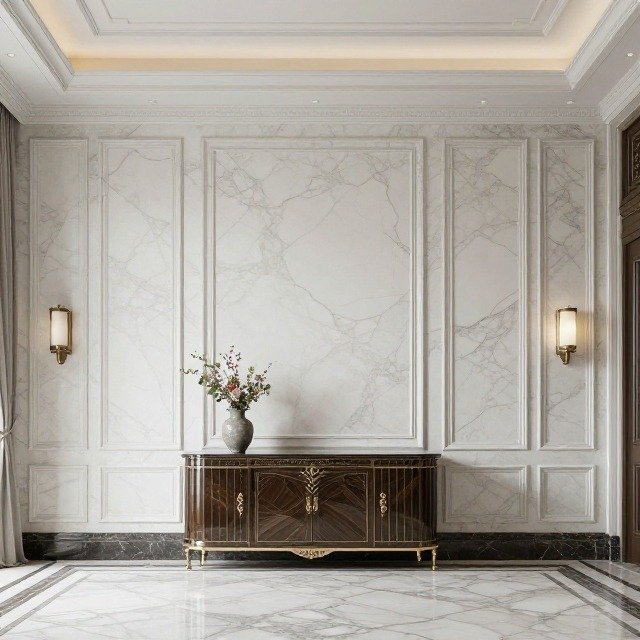
When executed with Italian marble renowned for its crisp ground, dramatic calcitic veins, and rich geological history, bookmatching transforms the raw stone into monumental symmetrical artwork.
1. What is Bookmatching?
When an Italian marble block is harvested and sent through gang saws or multi-wire cutting equipment, it produces a sequence of sequential slabs. In standard processing, slabs are polished on the same facing side.
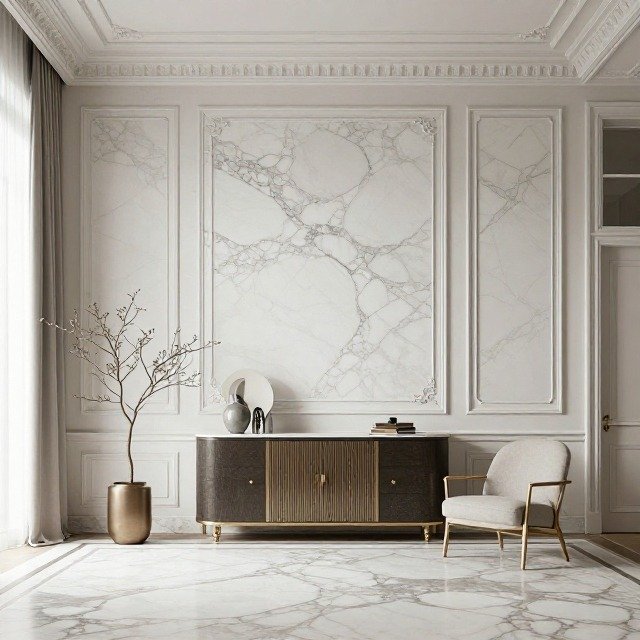
For bookmatching, the fabricator alternately polishes opposite faces (slab A on face 1, slab B on face 2). Placing these adjoining faces side by side along a central seam produces a mirror-image reflection of the mineral bands, crystalline fractures, and directional veining.
2. Core Techniques in Bookmatching
Precision stonework requires meticulous alignment from quarrying to final on-site dry-laying.
- Block Sourcing & Numbering: Natural slabs must come from consecutive cuts of the same quarry block. A missing slab breaks the symmetry permanently. Blocks are numbered sequentially at the gang saw to maintain matching pairs.
- Resin & Surface Finishing: Due to microscopic variations and natural fissures, slabs receive resin treatment and mesh backing on the unpolished side. Slabs paired for bookmatching are polished to a high-gloss reflective finish or honed to an ultra-smooth satin sheen depending on glare and application constraints.
- Digital Layout & Dry Laying: Before installation, fabricators use digital templating software (photogrammetry) to plan cuts around architectural boundaries (e.g., switches, doorways, cabinetry joints). A physical dry lay on the floor is essential to verify seam tolerance, vein transition, and color balance
- Joint Alignment & Mitering: Installers use minimal joint margins (1 mm to 1.5 mm epoxy joints tinted with color-matched pigments) to ensure the seam does not interrupt the continuous visual flow.
3. Structural Patterns & Layout Configurations
The geometric expression depends entirely on how many slabs are paired and how the axis of symmetry is set:
| Layout Style | Number of Slabs | Configuration & Vein Direction | Best Suited For |
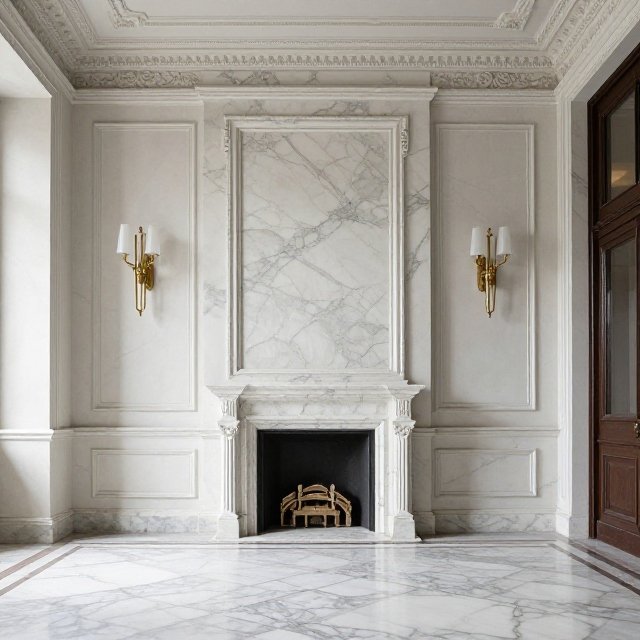
| Standard 2-Way Bookmatch | 2 Slabs | Symmetrical along a single central vertical or horizontal axis; creates a “butterfly” or chevron flow. | Living room TV media backdrops, vanity feature walls, fireplace surrounds, kitchen waterfall islands. |
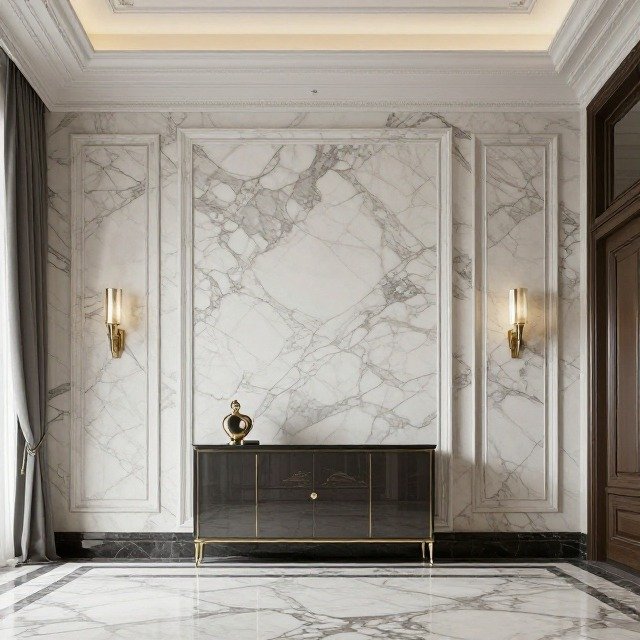
| 4-Way Quad Match (Diamond Match) | 4 Slabs | Mirrored across both vertical and horizontal axes, converging to form a central diamond, cross, or kaleidoscopic medallion. | Double-height foyer walls, central lobby floor medallions, expansive banquet backdrops. |
| Slip Match / Sequence Match | 2+ Slabs | Slabs placed side by side in sequential order without flipping; veins sweep continuously in one unified direction. | Long corridors, floor expanses, continuous kitchen run backsplashes. |
| End Match / Continuous Match | 2+ Slabs | Mirrored or aligned end-to-end lengthwise rather than across widths, creating an elongated linear composition. | Long dining tables, executive conference tops, continuous vertical columns. |
4. Celebrated Italian Marbles for Bookmatching
Not every stone is suitable for mirroring. Stones with uniform, monolithic grains (such as Botticino or Thassos) show little pattern continuity. Bookmatching demands bold, high-contrast, linear or brecciated veining:
- Statuario: Characterised by a luminous, milk-white background punctuated by bold, broad grey and anthracite ribbons. The distinct contrast makes Statuario the benchmark for dramatic diamond and butterfly panels.
- Calacatta Gold & Calacatta Viola: Featuring dramatic, flowing ribbons with amber, honey, or deep violet and wine undertones. Calacatta creates warm, sculptural centerpieces.
- Arabescato: Defined by dense, rounded grey webbed veins or breccia structures on a pure white field, creating intricate organic lacework when mirrored.
- Black Portoro (Nero Portoro): Quarried in the Gulf of La Spezia, this deep obsidian-black limestone features vibrant golden-yellow veins, producing an opulent, high-contrast luxury statement.
5. Visual Impact in Modern Architecture
- Organic Biophilic Symmetry: The human eye finds symmetry inherently calming and balanced. Bookmatching combines the unpredictable irregularity of geological movement with classical geometric proportion.
- Architectural Focal Point: Because bookmatched stone mimics large-scale wall tapestries or abstract paintings, it functions as a stand-alone architectural centerpiece, eliminating the need for extraneous decorative cladding or artwork.
- Spatial Illusion: When deployed across vertical wall runs with upward-pointing chevrons, the veining draws the gaze upward, increasing the visual height of ceilings in double-height entrance foyers and living spaces.
Conclusion
Bookmatching Italian marble bridges the gap between natural geological history and precision fabrication. While the technique demands strict curation, sequential slab integrity, and skilled installation, the result is completely unique: an architectural centerpiece that cannot be mass-produced or replicated.
Frequently Asked Questions (FAQs)
Q1: Why is bookmatched marble more expensive than standard slab installation?
Bookmatching requires purchasing consecutive slabs from the exact same block. In addition, fabricators must polish reverse faces at the processing facility, budget for cutting allowances around architectural openings, and dedicate extensive layout planning to maintain seamless joint alignment.
Q2: Can any marble variety be bookmatched?
Technically, any sequential slabs can be polished on opposite sides, but visually, stones with uniform coloration or faint granular textures show very little bookmatched effect. Bold, high-contrast veining (such as Statuario, Calacatta, Arabescato, and dynamic onyxes) delivers the intended visual impact.
Q3: How are joints concealed in bookmatched walls?
Installers keep seam allowances minimal (1 to 1.5 mm), bevel the edges subtly, and use specialized stone epoxies custom-tinted to match the background or vein tones, ensuring the eye travels past the seam without visual interruption.
Q4: Can bookmatched patterns be installed on floors?
Yes. Quad matching (four-way diamond layouts) is a popular technique for foyer entryways and central lobby floor medallions.

