
SECTION 1: Flagship In-Depth Article
Is Radon Gas in Granite Countertops Dangerous? Facts vs. Myths
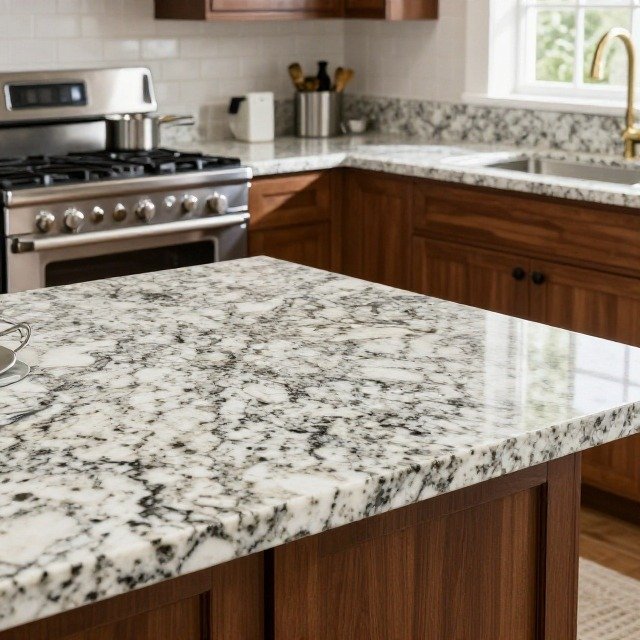
Granite has been the most commonly used in modern home renovations for centuries. It is heat resistant, has a distinct geological nature, is durable, and is easy to maintain. With all these benefits, there are still some competitors’ advertisements questioning, “Does your granite kitchen countertop expose your family to hazardous levels of radioactive radon gas?” Is it harmful?
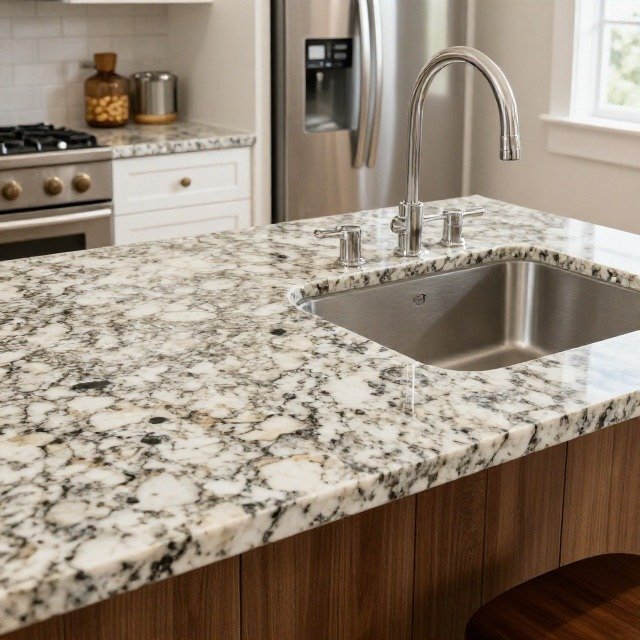
Radon is an invisible carcinogen that evokes legitimate concern. In order to evaluate the risk factor, one must understand the science behind it. We need to examine the physics of radioactive decay, geological data, and official findings from global environmental health agencies.
The Science: What Is Radon and Why Is It Inside Natural Stone?
Radon is a naturally occurring, odorless, colorless, and chemically inert radioactive noble gas. It is not an artificial chemical contaminant; it is a direct daughter product formed during the radioactive decay chain of naturally occurring uranium and radium.
Why Granite Contains Trace Radium
Granite is an igneous rock forged millions of years ago through the slow subterranean cooling and crystallization of magma under extreme pressures. Because the continental crust contains trace levels of radioactive minerals like uraninite, zircon, and apatite, the tiny fractions of these elements become naturally embedded inside the crystalline matrix of granite along with primary minerals like quartz and feldspar.
As these trapped elements decay over geological epochs, minuscule amounts of gaseous radon are produced. Some fraction remains sealed within the impermeable crystalline lattice, while a tiny fraction near the microscopic surface fissures escapes into the surrounding ambient air.
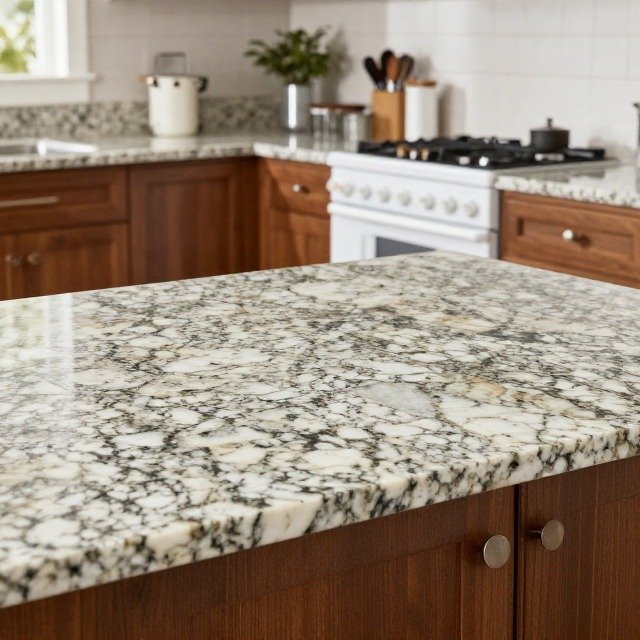
Facts vs. Myths: Dissecting the Most Common Radon Claims
| Popular Claim / Myth | Scientific Reality (Fact) | Verdict |
| “Granite countertops can emit dangerous concentrations of radon into home air.” | Virtually all commercial granite emits radon at levels far below public health thresholds. Normal residential air exchange rapidly dilutes any trace gas to undetectable levels. | MYTH |
| “Darker or exotic-colored granites emit the highest radiation.” | Color is dictated by feldspar, hornblende, and mica—not uranium content. Visual appearance has zero scientific correlation with radon emanation. | MYTH |
| “Regular topical sealing traps radon gas inside the stone.” | Chemical impregnating sealers block liquids and oils; they are porous to subatomic gas particles. Fortunately, trapping is completely unnecessary. | MYTH |
| “Engineered quartz surfaces emit zero trace radiation.” | Quartz slabs consist of 90–93% natural crushed stone aggregate bound by polymers; like all geological building materials, they carry harmless trace baseline radioactivity. | MYTH |
| “Indoor radon is a serious health hazard that warrants testing.” | Radon is the #1 cause of lung cancer in non-smokers worldwide. Over 99% of dangerous indoor radon enters from the soil and bedrock beneath foundations. | FACT |
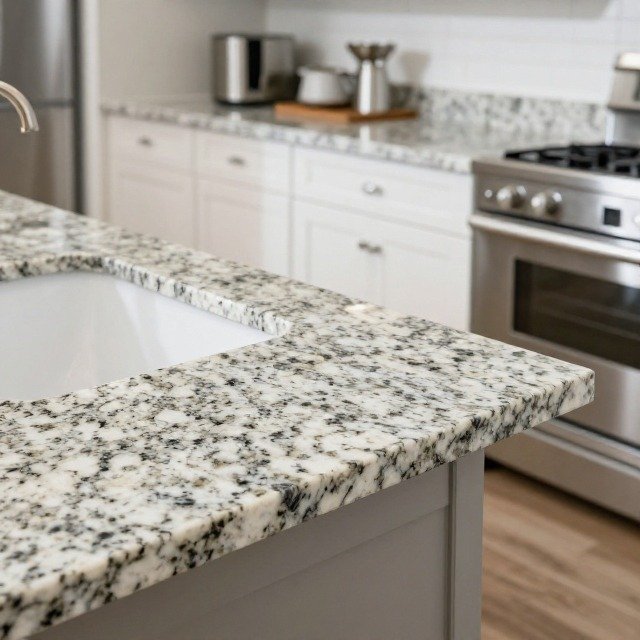
Myth 1: “Granite countertops emit dangerous amounts of radon gas.”
- The Reality: While granite countertops undeniably emit measurable amounts of radon, the emitted volume is statistically insignificant in residential environments.
- The Evidence: Comprehensive studies conducted by the U.S. Environmental Protection Agency (EPA), the Health Physics Society (HPS), and the Natural Stone Institute (NSI) have repeatedly demonstrated that typical natural stone installations increase indoor radon concentrations by mere fractions of a picocurie per liter.
Myth 2: “You can identify radioactive slabs by their color and origin.”
- The Reality: A slab’s hue is never an indicator of radiation hazard.
- The Evidence:
- Pink and red granites derive their distinctive coloration from potassium-rich alkali feldspar.
- Deep black “granite” used in architectural projects is frequently gabbro or diabase—mafic stones that geologically contain lower levels of uranium than light-colored continental felsic granites.
- Trace radionuclides are randomly distributed at the parts-per-million (ppm) scale. You cannot estimate radon emanation with the naked eye.
Myth 3: “Applying a standard granite sealer keeps radon from leaking out.”
- The Reality: Standard impregnating stone sealers do not prevent radon emission.
- The Evidence: Countertop sealers are engineered as breathable, silane-based barriers designed to prevent water and oil from penetrating stone pores. They do not present an impermeable obstacle to individual gaseous atoms of radon. Fortunately, because emission rates from granite are negligible, attempting to “seal in” the gas is completely unnecessary.
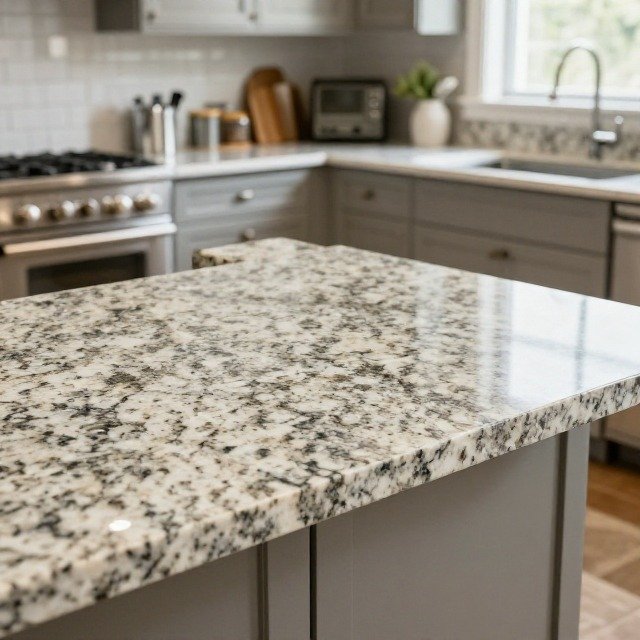
Myth 4: “Direct contact with granite causes dangerous external radiation exposure.”
- The Reality: External radiation exposure (gamma radiation) from leaning on or preparing meals on a granite countertop is negligible.
- The Evidence: Health physicists measure radiation absorption in millirems (mrem) or microsieverts ($\mu\text{Sv}$). The average human receives approximately 300 to 360 mrem of natural background radiation annually from cosmic rays, soil, air, and dietary sources (such as potassium-40 in bananas). Spending several hours per day directly adjacent to a typical granite countertop contributes less than 1 to 2 mrem per year—less than the radiation absorbed during a single commercial airline flight across the country.
Understanding the True Risk: Where Dangerous Radon Actually Comes From
The panic surrounding granite countertops often distracts homeowners from the genuine, documented source of household radon danger: the soil beneath the house.
[Soil & Bedrock Under Slab] ➔ [Cracks, Sump Pits & Utility Penetrations] ➔ [Indoor Living Air (Accumulation)]
- Soil Gas Intrusion: Over 99% of dangerous indoor radon concentrations enter through basement floor cracks, expansion joints, foundation footings, crawl spaces, and sub-slab drainage systems.
- Stack Effect: In heated homes, warm air rises and escapes through upper levels, creating negative pressure at the foundation level. This acts as a vacuum, drawing sub-slab soil gases directly into the home, where they can concentrate to hazardous levels.
- Test the Air, Not the Stone: Place an EPA-cleared short-test or digital radon detector (such as Airthings, EcoQube, or SunRADON) in the lowest lived-in level of your home (e.g., basement or ground floor).
- Understand the Thresholds:
- <2.0pCi/L: Acceptable baseline; minimal action needed.
- 2.0-4.0pCi/L: Consider mitigation, especially if levels remain elevated year-round.
- 4.0pCi/L: Action level; hire an NRPP (National Radon Proficiency Program) or NRSB-certified mitigation contractor.
- Avoid Uncalibrated Handheld Geiger Counters: Inexpensive consumer radiation meters detect ambient background gamma rays and electrical noise without scientific calibration, frequently causing unfounded panic. To isolate countertop emissions specifically, a certified health physicist must use an airtight radon accumulation flux chamber clamped directly to the stone.
Conclusion
The belief that granite countertops represent a dangerous source of radioactive radon is largely a persistent home-improvement myth. While natural granite stone does contain trace radioactive elements, independent scientific research confirms that its contribution to indoor air contamination is virtually immeasurable in standard residential homes.
Granite remains one of the safest, most durable, and most sustainable choices for your home. Enjoy your countertops with complete confidence—and protect your family’s health by conducting routine, standard whole-house radon tests every two years to monitor the ground beneath your foundation.
Frequently Asked Questions (FAQs)
1. Has anyone ever gotten lung cancer from granite countertops?
There is no medical or epidemiological case attributing lung cancer to countertop emissions. Radon-induced lung cancer is caused by prolonged, high-concentration inhalation of soil-derived radon trapped within homes.
2. Does running my kitchen exhaust fan eliminate radon?
Normal residential ventilation and kitchen range hoods easily disperse ambient gases. However, range hoods are not a solution for whole-house ground radon, which requires active sub-slab depressurization if levels exceed 4.0 pCi/L.
3. Are imported granite slabs from certain countries more dangerous?
While geological variations exist across international quarries, commercial stone shipments undergo baseline quality inspections. Independent studies examining domestic and imported slabs (from Brazil, India, Italy, and China) concluded that average emissions remain consistently well within safe limits.
4. Can I use a home radon test kit by setting it on my countertop?
No. An open-air test placed on a kitchen counter simply measures the general air quality of the room (which is dominated by HVAC airflow and foundation ground gas). It does not isolate or measure the countertop’s emissions.
5. How much does it cost to mitigate indoor radon if levels are high?
If your whole-house test reveals elevated radon levels, a professionally installed active sub-slab depressurization system typically costs between Rs 10,000 and 20,000, depending on your home’s footprint and construction style.

