
While renovating the bathroom vanity and kitchen countertop, the homeowners and interior designers frequently get confused about choosing granite vs. marble. Both have stunning natural stones quarried from the earth; they behave radically differently under daily wear and tear. A dropped kitchen knife or ceramic mug might leave granite unscathed while leaving scratches across the marble slab.
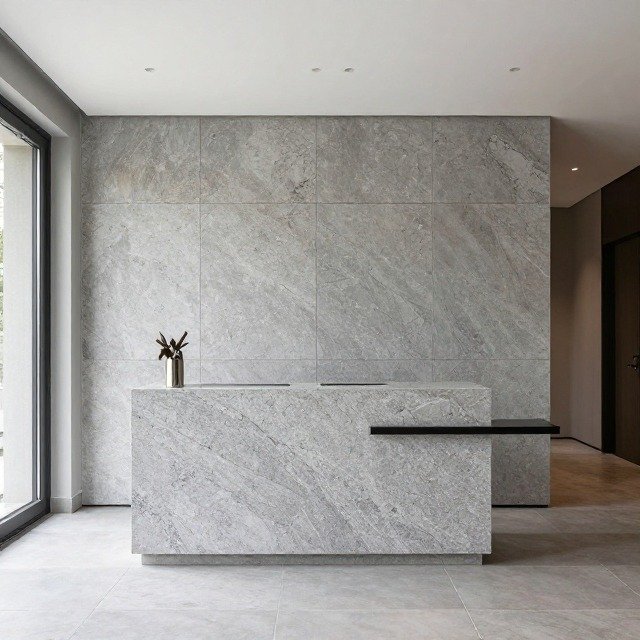
The secret behind this difference lies not in how heavy, dense, or thick the slab is, but in mineral chemistry. To understand why granite consistently outperforms marble in scratch tests, we look to one of geology’s most enduring benchmarks: the Mohs Hardness Scale.
1. What Is the Mohs Hardness Scale?
It is developed by German mineralogist Friedrich Mohs; the Mohs Hardness Scale measures a mineral’s relative resistance to being scratched. It ranks ten reference minerals from 1 (the softest) to 10 (the hardest):
- Talc (Scratched by a fingernail)
- Gypsum
- Calcite (Scratched by a copper coin)
- Fluorite
- Apatite (Scratched by a steel knife blade)
- Orthoclase Feldspar
- Quartz (scratches window glass)
- Topaz
- Corundum (Sapphire & Ruby)
- Diamond (hardest known natural mineral)
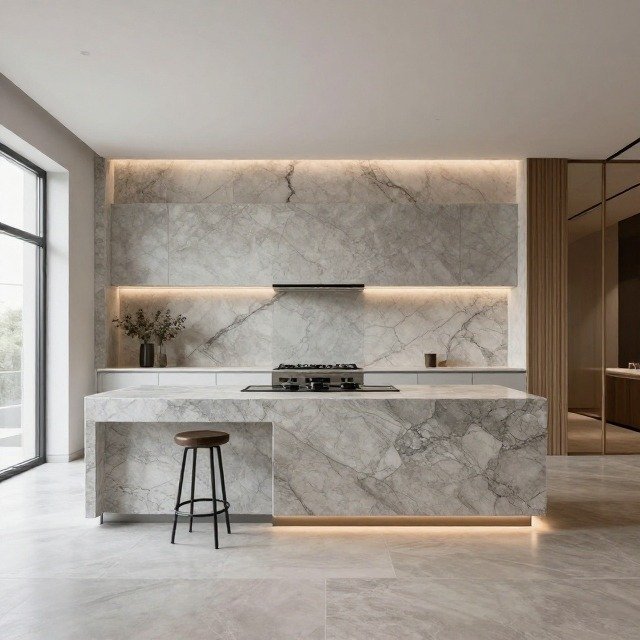
A Relative, Not Linear, Scale
A common misconception is that diamond (10) is only twice as hard as apatite (5). The Mohs scale is ordinal, not linear. A mineral at rank 7 (quartz) is exponentially harder than a mineral at rank 3 (calcite). On the absolute sclerometer or Vickers hardness scale, diamond is actually about 140 times harder than corundum, even though they sit adjacent on the Mohs scale.
2. The Mineral Breakdown: Why Composition Dictates Durability
Natural stones are aggregates of different minerals. The stone’s overall scratch resistance is governed primarily by the hardest and most dominant minerals in its matrix.
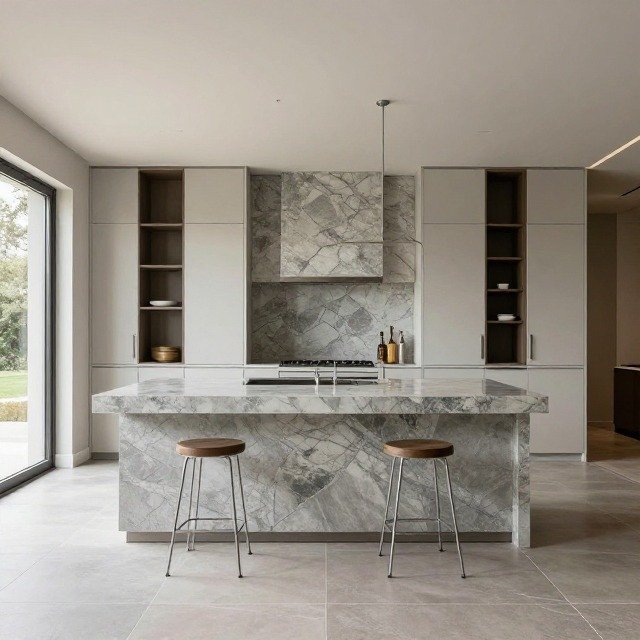
The Anatomy of Marble
Marble is a metamorphic rock formed when limestone or dolomite is subjected to intense heat and pressure deep within the Earth.
- Primary Mineral: Calcite (CaCO₃) or dolomite.
- Mohs Rating of Calcite: 3
- Everyday Vulnerability: Common kitchen items easily exceed a hardness of 3:
- Copper: 3.5
- Standard carbon/stainless steel kitchen knives: 5.0-5.5
- Ceramic dishware bases: 6.0-7.0
Because calcite sits low on the scale, virtually any hardened steel blade or ceramic plate base dragged across an untreated or polished marble surface will mechanically abrade and scratch it.
The Anatomy of Granite
Granite is an intrusive igneous rock formed by the slow cooling and crystallization of subterranean magma under high pressure.
- Primary Minerals:
- Quartz: Mohs Hardness 7 (typically 20% to 50% of the rock)
- Feldspar (Orthoclase / Plagioclase): Mohs Hardness 6 – 6.5 (typically 40% to 60%)
- Trace amounts of mica and hornblende.
- Overall Mohs Rating: 6 to 7
Because quartz and feldspar form an interlocking crystalline network, granite is substantially harder than the steel knives (5.5) used in everyday cooking. In fact, cutting directly on granite will dull your knife blades long before the steel can scratch the quartz crystals.
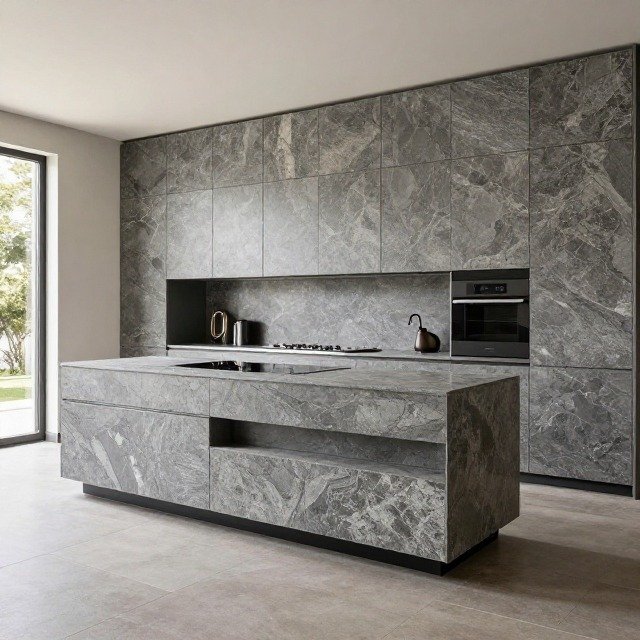
3. The Scratch Test: Head-to-Head Comparison
| Attribute | Marble | Granite |
| Rock Classification | Metamorphic | Igneous |
| Dominant Mineral | Calcite / Dolomite | Quartz & Feldspar |
| Mohs Rating | 3 to 4 | 6 to 7 |
| Knife Blade Test (5.5) | Scratches easily | Resists scratches |
| Ceramic Cup Bottom (6.5) | Causes deep gouges | Highly resistant |
| Acid/Etch Resistance | Poor (reacts with lemon and vinegar) | Excellent (inert to mild acids) |
| Ideal Application | Low-traffic vanities, mantels, accents | Busy kitchens, heavy-use countertops |
4. Etching vs. Scratching: A Crucial Distinction
Homeowners often confuse a scratch with an etch mark.
- Scratching is physical abrasion where an object harder than the stone carves into its surface.
- Etching is a chemical reaction. Because marble is composed of calcium carbonate (CaCO₃), acidic liquids like lemon juice, tomato sauce, and wine dissolve the top layer of calcite, leaving behind dull, whitish rings that look like scratches to the naked eye.
Granite is composed primarily of silicates (silicon and oxygen), which do not react with household food acids. Thus, granite avoids both physical scratching from kitchen tools and chemical etching from citrus or vinegar.
Conclusion
When granite goes head-to-head with marble in a scratch test, the winner is predetermined by geology. Granite’s interlocking matrix of quartz (Mohs 7) and feldspar (Mohs 6) creates an armor-like shield that easily deflects everyday blades and abrasive dishware. Marble, composed of soft calcite (Mohs 3), offers timeless classical beauty but yields to ordinary kitchen implements.
If your priority is low-maintenance resilience and heavy culinary use, granite is the definitive winner. If you prefer romantic patinas and subtle veining and are willing to embrace gentle care and periodic sealing, marble remains an unmatched luxury.
Frequently Asked Questions (FAQs)
Can granite ever be scratched?
Yes. While granite resists standard kitchen knives and tableware, materials rated Mohs 7 or above—such as topaz, tungsten carbide, diamond rings, and abrasive scouring powders containing silicon carbide—can scratch it.
Can you fix scratches in marble?
Minor surface scuffs and light etch marks can often be buffed out using a specialty marble polishing powder and a damp microfiber pad. Deeper scratches require wet-sanding with diamond-grit abrasives and professional stone restoration.
Does sealing marble increase its scratch resistance?
No. Stone sealers are penetrating impregnators designed to reduce porosity and liquid absorption (staining). They do not create an impenetrable physical barrier or alter the natural Mohs hardness of the calcite crystals.
Why do some commercial “granites” scratch easily?
In the dimension stone trade, stones like serpentinite, dolomitic marble, or soapstone are sometimes mislabeled as “black granite” or exotic granite. Authentic geological granite always consists mainly of quartz and feldspar and will never scratch with a standard penny or steel knife.

