
Few materials for the interior design command the immediate prestige and staggering price tag of Calacatta Gold Marble. Italian marble is known for its durability, authenticity, and timeless beauty. The rare bookmatched pairs are costly, especially calacatta gold marble.

Why does this sedimentary rock transform by heat and pressure fetch a highly expensive cost?
The answer lies at the intersection of geological rarity, perilous mountain extraction, extreme yield loss, and centuries of architectural mythology.
1. Single-Source Geography: The Apuan Alps of Carrara
While lower-grade commercial marble is quarried across Greece, Turkey, India, and China, authentic Calacatta Gold comes from exactly one place on Earth. The Apuan Alps surround Carrara in Tuscany, Italy.
Carrara is not a single quarry; it is a vast mountainous region with hundreds of distinct extraction sites. However:
- Carrara marble, which is available in greyish-white stone with feathery veins, is quarried in abundance from lower, easily accessible basins.
- Calacatta Gold is harvested almost exclusively from high-altitude, boutique quarries in the Monte Altissimo and Seravezza basins.
These high-altitude quarries face extreme winter weather and limited extraction windows each year. The sheer physical difficulty of harvesting 30-ton blocks from near-vertical Alpine faces drives up the baseline production cost long before the stone touches a saw blade.
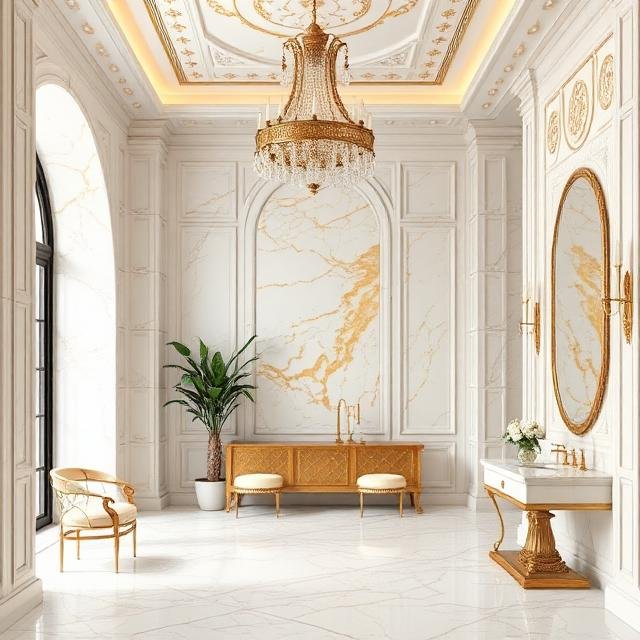
2. The Scarcity Matrix: The Rarest Vein in the Mountain
To understand the price one must understand how Calacatta Gold forms.
All marble begins as limestone subjected to metamorphism. Calcutta Gold occurs when specific mineral impurities like pyrite, dolomite and iron oxide infiltrate the recrystallizing calcite matrix under precise temperature and pressure.
- Limestone Deposition (Prehistoric)
- Deep Tectonic Subduction (Heat & Pressure)
- Trace Mineral Infiltration (Iron Oxide & Pyrite)
- Pure Recrystallized Calcite Matrix (Calacatta Gold Vein)
3. Visual Anatomy: What Sets Calacatta Gold Apart?
To the untrained eye, white Italian marbles may appear similar. To architects and stone connoisseurs, the distinctions are definitive:
| Marble Variety | Background Color | Vein Structure | Primary Vein Colors | Price Tier |
| Carrara Classic | Cool greyish-white / soft silver | Soft, dense, linear/feathery | Charcoal, slate grey | Moderate ($) |
| Statuario | Bright, icy white | Bold, dramatic, thick ribbons | Charcoal, dark steel grey | High ($$$) |
| Calacatta Gold | Warm milky, luminous white | Broad, sweeping, open ribboning | Taupe, charcoal, honey, gold, amber | Ultra-Luxury ($$$$$) |
Key Aesthetic Hallmarks of Top-Grade Calacatta Gold:
- Luminous “Field” (Background): It does not lean cold blue or chalky grey; it possesses an unmistakable warm, glowing porcelain warmth.
- Dramatic Vein Dynamics: Unlike the dense webbing of Carrara, Calacatta has expansive, negative white space punctuated by thick, dramatic “rivers” of movement.
- Multi-Chromatic Veining: A single vein often transitions seamlessly from soft charcoal and warm taupe into shimmering caramel, honey, and brushed gold.
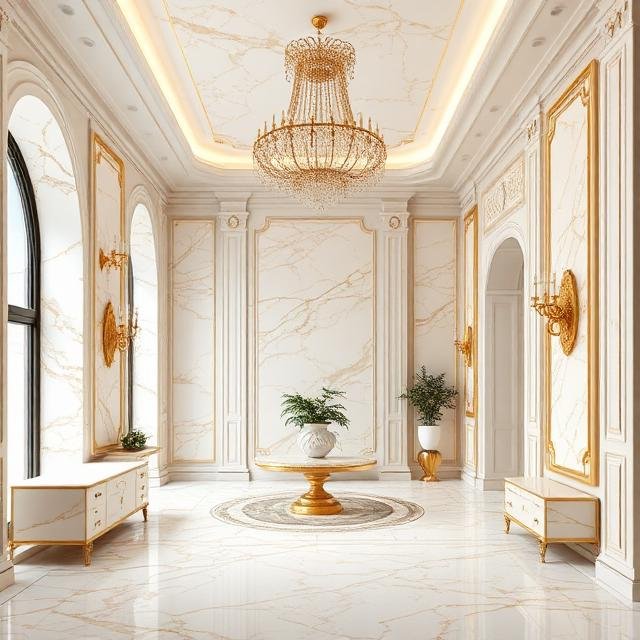
4. The Fabrication Gamble and Staggering Waste Rates
When buying a slab of Calacatta Gold, you are paying not only for the stone on your counter, but also for the rock that crumbled during extraction and processing.
- Fissures and Structural Faults: High-altitude tectonic stone contains natural micro-fractures (pelosi). A block that appears solid on the outside can shatter into unusable fragments the moment diamond-wire gang saws begin slicing it.
- Extraction Waste: Up to 70% of quarried material in luxury quarries is discarded as aggregate or industrial gravel because it fails to meet the strict color, purity, and veining standards of premier grade slabs.
- Bookmatching Premium: Slicing consecutive slabs that mirror each other like an open butterfly book (bookmatching) requires flawless structural integrity across consecutive cuts. A single internal defect ruins the pair.
5. The Grade Hierarchy: Why Prices Vary Within Calacatta
Not all Calacatta Gold is equal. Slabs are strictly graded at the Italian distribution yards:
- Extra / First Choice: Pure crystalline white base with no yellowing patches (macchie), no muddy grey clouding, and crisp, balanced gold/taupe veining. This commands top-tier pricing ($350–$500+/sq. ft.).
- Standard Choice: Beautiful veining, but the background field may have slight grey undertones or uneven vein distribution ($250–$350/sq. ft.).
- Commercial Grade: Heavier grey clouding, erratic brownish streaks, or smaller cut sizes ($150–$220/sq. ft.).
6. Long-Term Value & “Quiet Luxury” Heritage
Calacatta Gold is not a passing trend. It has been specified across centuries in Renaissance palazzos, Roman basilicas, and landmark luxury residences. In modern real estate, a kitchen island or primary bath rendered in high-grade Calacatta Gold serves as an unmistakable statement of architectural pedigree that holds value over decades.
Frequently Asked Questions (FAQs)
Is Calacatta Gold harder or more durable than other marbles?
No. Chemically, Calacatta Gold is primarily calcium carbonate (CaCO3). It has a Mohs hardness of roughly 3 to 4, making it identical in physical hardness to Carrara and Statuario. It remains susceptible to acid etching (from citrus, vinegar, or wine) and scratching. Its premium price is driven entirely by scarcity and aesthetics, not physical hardness.
What is the difference between Calacatta Gold and Calacatta Borghini?
Calacatta Borghini comes from the historic Borghini quarry in Carrara—one of the oldest active quarries in the region (dating back to Roman times). It is famed for its distinctive warm amber/honey veining and warm ivory base. Calacatta Gold is a broader designation for top-tier stones exhibiting golden-caramel veining from premium Carrara basins.
Can quartz or porcelain truly replicate Calacatta Gold?
Engineered quartz and sintered porcelain have made rapid strides in digitally printing Calacatta-like patterns. However, they lack the sub-surface optical depth, translucency, and crystalline light refraction of genuine metamorphic calcite. Under natural daylight, authentic marble has a soft inner glow that printed surfaces cannot match.
How do I maintain and protect Calacatta Gold marble?
- Apply a high-grade penetrating, breathable solvent sealer every 6–12 months.
- Clean immediately with pH-neutral stone cleaners (avoid acidic or bleach-based sprays).
- Consider a honed (matte) finish rather than polished for kitchen islands; honed finishes disguise light etching and micro-scratches far better than high-gloss surfaces.
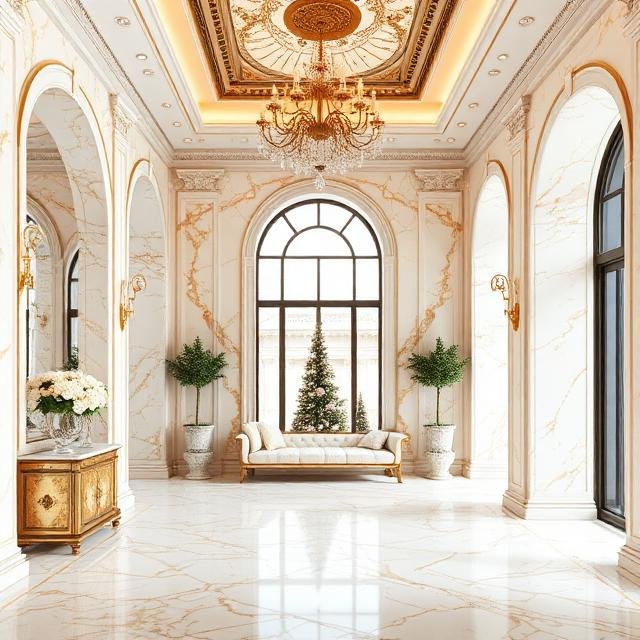
Conclusion
Calacatta Gold marble is expensive because it is nature’s rare masterpiece: an elusive geological anomaly formed millions of years ago, harvested from hazardous Alpine peaks, refined with staggering material loss, and prized for timeless aesthetic harmony. When you invest in Calacatta Gold, you are not simply purchasing a countertop—you are acquiring a non-renewable, curated piece of Earth’s geological history.

