
Makrana White Marble is one of the most celebrated stones. It is mined from the quarries of Nagaur district in Rajasthan. The calcitic marble is one of the most durable and stood the test for decades. The modern architect designs often lean on imported Italian marble for their dramatic vein pattern, while Makrana marble is unmatched in structural durability, purity, and natural resilience.
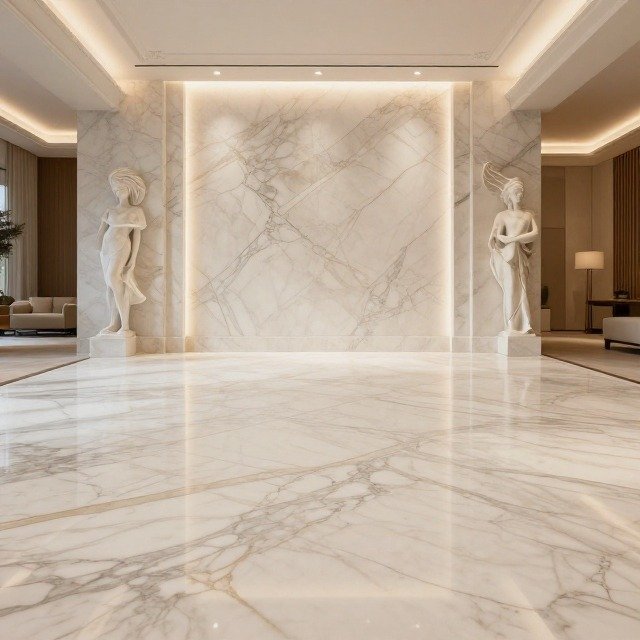
1. Geological Origins and Architectural History
Makrana marble belongs to the Aravalli fold mountain system, and it is formed with regional metamorphism. Therefore, the stone possesses an interlocking granoblastic crystalline structure of nearly 98% pure calcium carbonate.
The stone’s legacy spans monumental landmarks across the Indian subcontinent:
- The Taj Mahal, Agra (1631–1648): It was commissioned by Mughal Emperor Shah Jahan; over 20,000 tonnes of pure Makrana white marble were transported by bullock carts to Agra. Even after four decades of exposure to sun, rain, and modern atmospheric shifts, it retains its luminosity.
- Victoria Memorial, Kolkata (1906–1921): It proves the stone’s resistance to humidity in the tropical conditions, coastal salinity, and acidic monsoon rainfall without structural decay.
- Dilwara Jain Temples, Mount Abu: Notable for micro-carvings, filigree ceilings, and delicate stone brackets that require brittle-free, dense marble capable of holding intricate chiseling without snapping.
Rarity Marble - Sheikh Zayed Grand Mosque, Abu Dhabi: Makrana stone was selected along with the Greek and Macedonian varieties for its ability to withstand extreme desert heat.
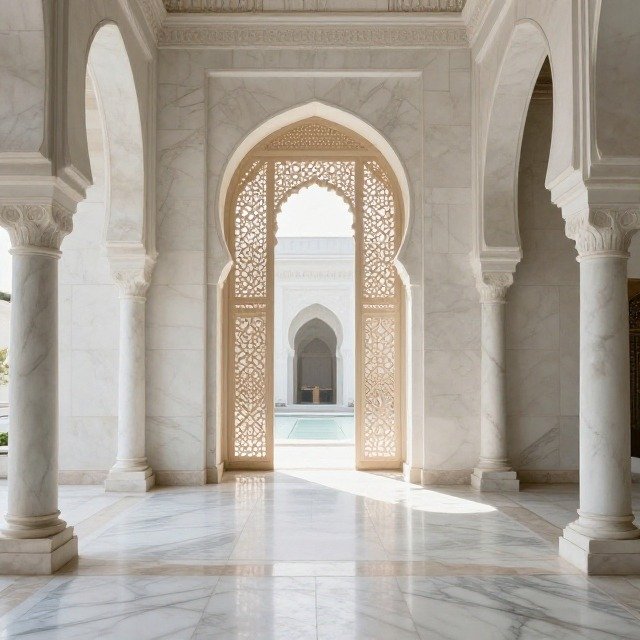
2. Quality Grades and Varieties
In the Makrana trading, marble is categorized by its quarry range, base translucency, and the presence of natural grey or brown silicate banding.
| Variety / Grade | Visual Profile | Calcite Content | Key Applications |
| Makrana Pure White (Sangemarmar) | Pristine, milky-white background with zero or near-zero figures and high light refraction. | ~98%–99% | Sanctum sanctorums, high-end temple idols (murtis), luxury residential flooring. |
| Makrana Albeta | Milky white ground with subtle, dispersed golden-brown, greyish, or hazel pencil veining. | ~96%–98% | Signature living areas, premium villas, bespoke wall cladding. |
| Makrana Dungri (Doongri) | Off-white to pearlescent base with flowing grey or black zebra-pattern bands. | ~94%–97% | Large-scale residential flooring, staircases, and commercial lobbies. |
| Makrana Kumari | Greyish-white base featuring pronounced geometric figures and darker lines. | ~90%–94% | High-traffic corridors, rental properties, and budget-conscious institutional flooring. |
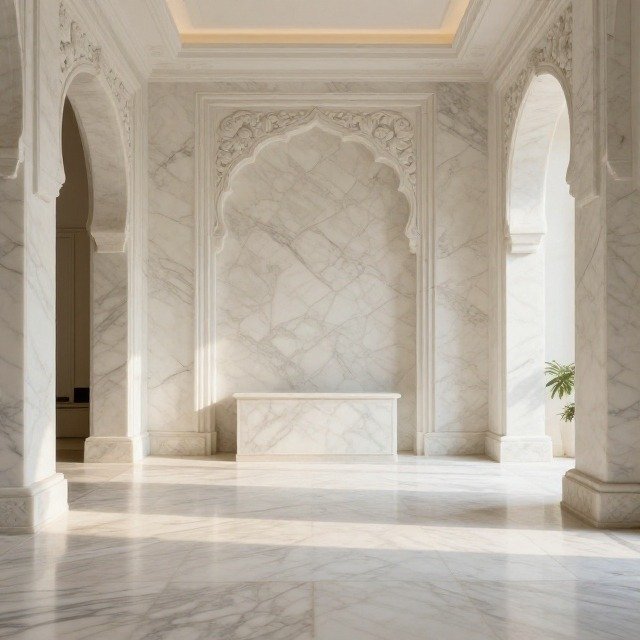
3. Why Makrana Outlasts Italian Marble
While Italian marbles like Carrara, Statuario, or Botticino provide dramatic bookmatched aesthetics, Makrana is structurally more durable for functional surfaces:
No Resin or Fiber-Mesh Backing Required
Italian marble is much softer compared to granite and quartz; it is naturally brittle and porous. Most Italian slabs arrive backed with epoxy resin and fiberglass mesh to prevent breakage during quarrying, transit, and sawing. In contrast, Makrana slabs require no mesh reinforcement or artificial resin sealants; they are cut, dry-laid, and polished directly.
Resistance to Yellowing and Discoloration
Italian marbles frequently contain trace iron silicates and rely on chemical epoxy coatings. Over time, UV radiation and alkaline cement reactions oxidize these fillers, causing the stone to yellow or develop cloudy patches. Pure Makrana has virtually no iron or foreign resin. Regular maintenance, cleaning, and foot traffic buff its crystalline calcite, making it whiter and more luminous over generations.
Lower Water Absorption and Chemical Density
Due to its interlocked metamorphic structure, Makrana possesses lower water absorption than standard European sedimentary marbles. It does not develop hollow pinholes over decades of wear, making it better suited to Indian cleaning routines and wet mopping.
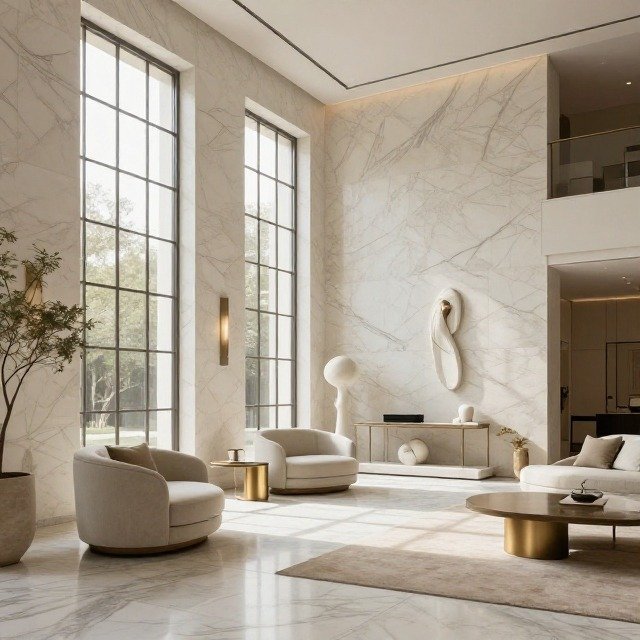
Frequently Asked Questions
Does Makrana marble turn yellow over time?
No. Genuine high-grade Makrana (especially Albeta and Pure White) contains no iron impurities or surface epoxy layers. Natural wear and pH-neutral maintenance burnish the calcite crystals, brightening their appearance over the years.
How can one identify genuine Makrana marble from fake stones?
Authentic Makrana slabs do not require a fiber net or resin coating on the back. The stone exhibits a sugary, crystalline calcite grain. Additionally, rubbing two dry pieces of Makrana together produces a faint, characteristic smell of calcitic lime.
Can Makrana marble be re-polished?
Yes. Because the stone is solid calcite without surface coatings, it can be ground down and diamond-polished multiple times across decades, restoring its original factory sheen.
Conclusion
Italian marble delivers dramatic contemporary luxury, but Makrana White Marble represents true generational value. Its high calcite purity, absence of artificial resin stabilization, and proven architectural longevity make it an enduring natural stone for floors, temples, and residential spaces.

