
Large marble slabs often defined as panels exceeding the thickness range with different thicknesses, have become the hallmark of luxury in contemporary architecture. From expansive corporate lobbies and luxury hotel atrium walls to high traffic retail flooring and executive boardrooms, these monumental stones deliver uninterrupted visual continuity and unmatched natural grandeur. However, their sheer mass, movement stresses and moisture sensitivity require rigorous installation standards.
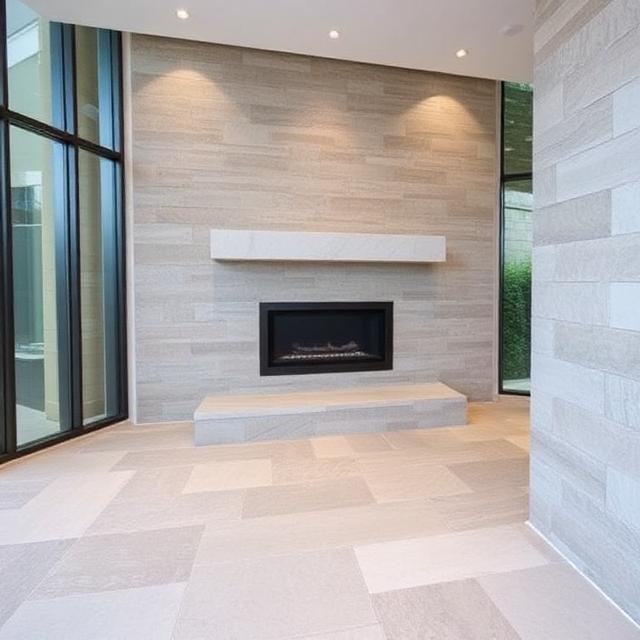
This technical guide outlines the critical installation best practices for large format commercial stone marble slabs in high-stress commercial environments, adhesive selection, structural anchoring, cost estimations, and long-term maintenance.
1. Substrate Evaluation and Structural Preparation
The foundation of any successful large format marble installation lies in substrate integrity. Because oversized stone panels lack flexibility, even micro-deflections in the substrate will project tensile stress into the slab, resulting in structural cracking.
- Deflection Tolerances: Structural subfloors and wall framing must meet strict deflection criteria. For natural stone installations, subfloor deflection must not exceed L/720 under total design load (compared to L/360 for standard ceramic tiles). Vertical stud framing must achieve L/600 rigidity under lateral loads.
- Flatness Standards: Subfloors and wall backing must conform to ANSI A108.02 standards. Max permissible variation is no more than 1/8 inch in 10 feet (3\,\text{mm} in 3\,\text{meters}) from the required plane, with no more than 1/16 inch (1.5\,\text{mm}) variation in 24 inches (600\,\text{mm}). Any unevenness must be corrected using self-leveling underlayments (SLUs) or polymer-modified render coats before setting stone.
- Moisture & Curing: Concrete substrates must be fully cured (minimum 28 days) with a moisture vapor emission rate (MVER) below 15\,\text{kg}/100\,\text{sq. m}/24\,\text{hrs} (approx. 3\,\text{lbs}/1,000\,\text{sq ft}/24\,\text{hrs}) per ASTM F1869, or under 75% relative humidity per ASTM F2170. Waterproofing and moisture mitigation membranes must be applied when slabs are installed over slab-on-grade or sub-grade concrete.
2. Handling, Movement & Material Acclimatization
Large marble slabs are susceptible to thermal expansion, transport stresses, and flexural breakage before final bedding.
Critical Handling Mandate: Large format marble panels must always be transported vertically using specialized A-frames, mechanical vacuum suction frames with multiple pad stabilization, and edge protection. Never transport or lift large slabs flat without structural rigid support frames.
- Acclimatization: Marble slabs must be delivered to the installation site at least 48 to 72 hours prior to installation to acclimatize to ambient temperature and relative humidity levels maintained during occupancy.
- Back-side Inspection & Mesh Removal/Priming: Most large thin marble slabs are factory-backed with fiber-reinforced resin mesh for shipping stability. Installers must verify compatibility between the resin mesh backing and setting mortars. Epoxy backings often require specialized epoxy adhesives or specialized bond-promoting primers (such as polyurethane or modified acrylic primers) rather than standard polymer-modified thin-set mortars.
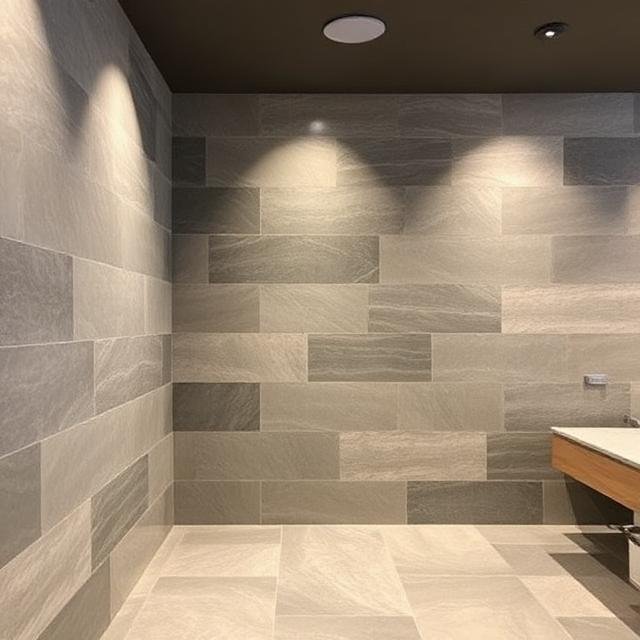
3. Commercial Budgeting & Cost Breakdown (INR)
When planning large format marble slab installations in commercial projects across India, project managers and specifiers must account for specialized installation tooling, high-grade adhesives, and structural anchoring systems.
| Cost Component | Typical Commercial Cost Range (per sq. ft.) | Key Scope & Technical Drivers |
| Marble Slabs (Raw Material) | ₹350 – ₹2,500+ / sq. ft. | Variety (e.g., Statuario, Calacatta, Indian Makrana/Katni), thickness (16\,\text{mm}\text{–}20\,\text{mm}), and book-matching. |
| Substrate Prep & Leveling | ₹60 – ₹150 / sq. ft. | High-strength self-leveling compounds, moisture mitigation barriers, and stud framing reinforcement for L/720 rigidity. |
| Adhesives & Setting Mortars | ₹80 – ₹220 / sq. ft. | Polymer-modified mortars (ANSI A118.15), 100% solid epoxy mortars for water-sensitive stone, and neutral-cure silicones. |
| Mechanical Anchoring Systems | ₹120 – ₹350 / sq. ft. | Grade 304/316 stainless steel kerf anchors, pin clamps, or aluminum sub-framing channels for vertical walls (>3\,\text{m}). |
| Specialized Installation Labor | ₹250 – ₹600 / sq. ft. | Certified stone masons, vacuum suction frame operation, mechanical slab-leveling clips, and precision miter cuts. |
| Sealing & Post-Install Care | ₹40 – ₹90 / sq. ft. | Deep diamond honing/polishing, breathable fluorochemical sealers, and temporary heavy-duty surface protection boards. |
Turnkey Cost Summary
- Standard Commercial Floor / Feature Wall: ₹900 – ₹1,800 per sq. ft. (total installed cost)
- High-Rise / Luxury Dry-Hung Cladding: ₹2,000 – ₹4,000+ per sq. ft. (total installed cost including imported stone and structural sub-framing)
4. Adhesive Systems and Coverage Optimization
A primary cause of large-format stone failure is inadequate mortar contact, leaving hollow cavities that buckle under point-loads or trap moisture.
| Application Type | Recommended Setting Material | Coverage Target | Key Technical Consideration |
| Commercial Interior Floors | Medium-Bed Polymer-Modified Mortar (ANSI A118.4/A118.11) or C2ES1/S2 classification | 95% minimum (100% in wet/exterior areas) | Use full-coverage directional troweling; avoid swirl or spot bonding. |
| High-Rise/Vertical Cladding | Two-Component Epoxy / Mechanical Anchoring Systems | 100% Structural Bond + Mechanical Pinning | Required for heights exceeding 3\,\text{meters} or slabs thicker than 15\,\text{mm}. |
| Moisture-Sensitive Marble (e.g., Green/Black Marble) | 100% Solid Epoxy Adhesive (ANSI A118.3) | 100% Coverage | Water-based thin-sets trigger dimensional curling and water-staining. |
Back-Butter & Straight-Line Troweling Method
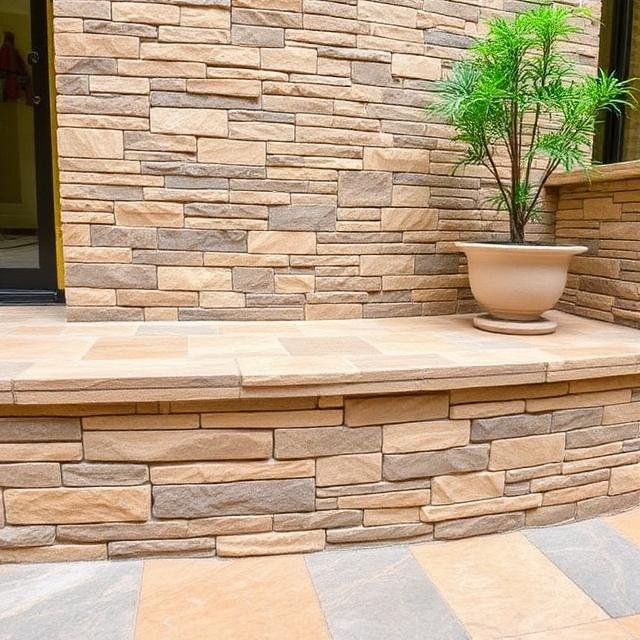
To eliminate air pockets and achieve maximum bond strength:
- Apply a thin key coat of mortar to the substrate using the flat side of the trowel, followed by combing in a single direction with a large-format euro-notch or slant-notch trowel (e.g., 1/2″ \times 1/2″ or 3/4″ notch).
- Apply a thin skim coat (back-buttering) of mortar to the back of the marble slab to ensure 100% wet-out.
- Place the slab parallel to the mortar ridges and collapse the ridges by sliding the slab back and forth perpendicular to the trowel lines (approximately 10\text{–}15\,\text{mm} movement) under firm mechanical press or rotary vibration tools. Never use spot-bonding (“dot and dab”) on commercial installations.
5. Mechanical Anchoring for Vertical Applications
For commercial vertical feature walls, elevator banks, and building facades, direct adhesion alone is insufficient and non-compliant with structural codes in most jurisdictions.
- Combined Anchoring: Combine structural adhesive bedding with stainless steel (Grade 304 or 316) kerf anchors, pin systems, or split-tail anchors slotted directly into pre-cut slab edges.
- Dry-Hanging Curtain Systems: For extreme vertical heights, implement an aluminum or stainless steel sub-framing channel system (ventilated facade design) where individual marble panels are mechanically hooked into structural channels. This decouples building movement from the stone facade and prevents thermal bridging.
6. Movement Joints, Grouting, and Lippage Control
Large format marble slabs expand and contract due to thermal changes and structural movement. Omitting expansion joints guarantees cracked slabs or popped tiles.
Movement Joint Standard (TCNA EJ171 / BS 5385): Never carry marble continuously over building control joints. Perimeter expansion joints must be installed at all wall/floor junctions, column bases, and changes in substrate materials. Interior floor installations require movement joints every 6 to 7.5 meters (20 to 25 feet) in each direction, reduced to 2.5 to 3.5 meters in sunlit or heated areas.
- Lippage Prevention: Use heavy-duty mechanical slab leveling clip systems (screw or wedge cap systems designed for natural stone) to maintain perfectly flush edges during setting. Ensure joints are a minimum of 2\,\text{mm} to 3\,\text{mm} wide; butt-jointing large format marble is strictly prohibited by industry standards.
- Flexible Joint Fillers: Movement joints must be sealed with permanently flexible, non-staining neutral-cure silicone or polyurethane sealants matching the stone color. Avoid standard sealants that exude silicone oil into porous marble edges, causing irreversible frame-staining.
7. Post-Installation Protection and Sealing
Commercial construction sites present significant hazards after marble installation, from heavy boot traffic to trades carrying ladders and equipment.
- Curing Time: Allow light foot traffic only after 24 to 48 hours for fast-setting mortars, or 7 days for standard mortars. Do not execute heavy diamond polishing or mechanical honing for at least 7 to 14 days after completion of setting.
- Surface Protection: Cover newly laid floors with breathable protective floor guards (such as heavy-duty temporary floor protection boards with non-staining breathable underlayments). Never apply adhesive tape directly onto the natural marble surface.
- Penetrating Impregnating Sealer: Apply a high-performance, breathable fluorochemical impregnating sealer after the grout and mortar have fully cured. Penetrating sealers protect against oil and water-based stains without forming an impermeable film that traps sub-slab vapor.
Conclusion
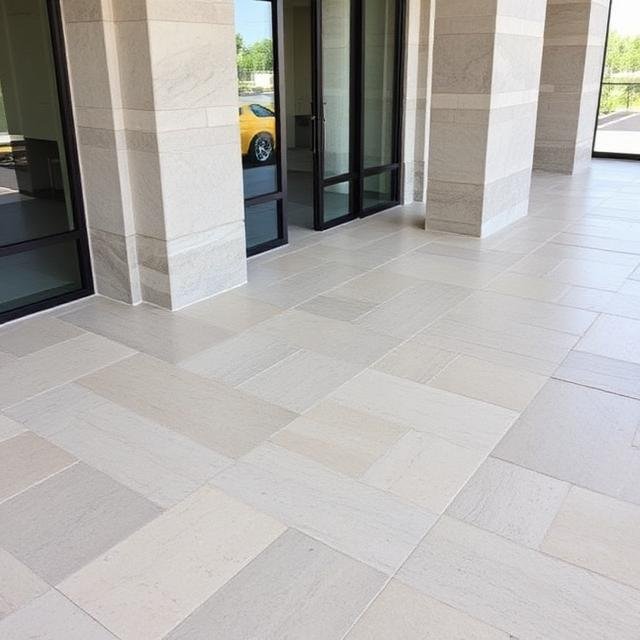
Installing large format marble slabs in commercial environments is an engineering discipline that demands precision, specialized tooling, and strict adherence to structural standards. By prioritizing substrate flatness (L/720 deflection), selecting high-performance polymer or epoxy adhesives, utilizing 100% full-coverage troweling techniques, incorporating stainless steel mechanical anchors on vertical surfaces, and honoring movement joints, architects and contractors can ensure visually stunning, highly durable commercial stone installations that endure for decades.
Frequently Asked Questions (FAQs)
Q1: What is the turnkey installation cost for large format marble in Indian commercial projects?
A: Turnkey costs typically range from ₹900 to ₹1,800 per sq. ft. for standard commercial floors and walls, and can exceed ₹2,000 to ₹4,000+ per sq. ft. for high-rise dry-hung vertical cladding with imported marble varieties.
Q2: Can large format marble slabs be installed directly over existing commercial ceramic flooring?
A: Yes, provided the existing floor is structurally sound, fully bonded, flat within L/720 standards, and properly prepared. The existing ceramic surface must be mechanically scarified or abraded to remove glazes, thoroughly cleaned, and primed with a specialized bonding primer before applying polymer-modified thin-set mortar (ANSI A118.15).
Q3: Why is spot-bonding (“dot and dab”) strongly discouraged for commercial marble installations?
A: Spot-bonding creates hollow voids beneath up to 70% of the slab area. In commercial spaces, heavy foot traffic, rolling carts, or point loads will concentrate stress over these empty voids, causing immediate cracking. Furthermore, voids trap moisture and air, leading to uneven moisture telegraphing, efflorescence, and compromised shear bond strength.
Q4: How do you prevent moisture staining or curling in green or dark marble slabs?
A: Green marble (serpentine) and certain dark marbles are water-sensitive and absorb water from cementitious thin-set mortars, causing them to warp, curl, or develop permanent dimensional distortion. These stones must always be installed using 100% solid reaction-resin epoxy adhesives (ANSI A118.3) that contain no water.
Q5: What mechanical anchoring system is best for interior marble feature walls in high-rise buildings?
A: For interior vertical installations exceeding 3 meters or using slabs over 15{mm} thick, a kerf-anchor pin system or split-tail stainless steel anchor system embedded into the stone edges and secured to metal stud/channel framing is standard. Dry-hanging aluminum split-rail systems are preferred for extreme stability and speed.

