
The definitive guide to balancing high drama, tactile contrast, and kitchen durability by uniting luminous marble with grounded dark granite.
For century kitchen countertops has uniform countertops throughout the space. Homeowners usually select a single slab of granite or marble. However, luxury transitional kitchen architecture has decisively broken away from this monotonous uniformity. At the forefront of this design, one of the most compelling surface pairings in high-end design, is the luminous dynamic marble anchored by deep-grounded dark granite perimeter counters.
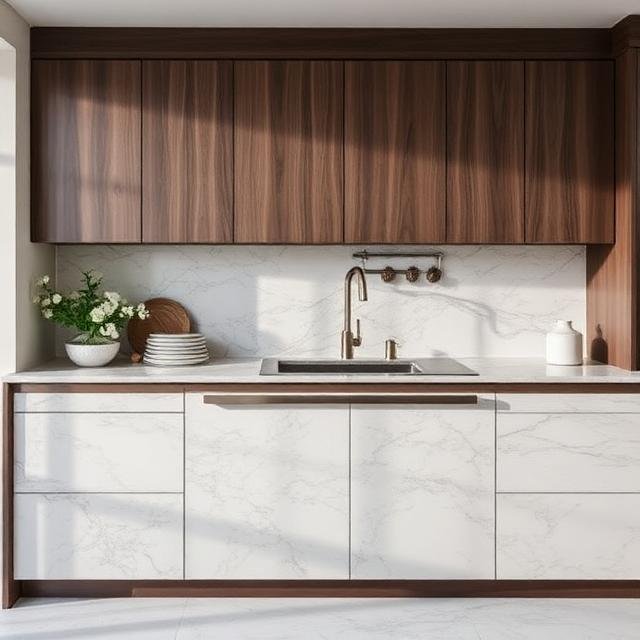
Far from a haphazard combination, pairing a statement marble with shadowy perimeter counters solves the eternal kitchen dilemma. How to capture the ethereal and irreplaceable of natural marble without submitting the entire working perimeter to harsh everyday kitchen abuse. Here is deep analysis of why this combination works. How to balance the elements and how to execute the pairing with architectural designs.
1. The Design Psychology: Why High-Contrast Stones Work
The kitchen island has evolved from a simple prep station into the social hearth of modern living. Treating the island as a standalone architectural centerpiece demands visual distinction. When an island is clad in dramatic Calacatta, Carrara, or Statuario marble, its luminous white ground and fluid veining draw the eye like an illuminated stage.
Conversely, perimeter countertops sit underneath wall cabinetry, flank cooking ranges, and handle the heavy physical lifting of food preparation. When clad in dark granite—such as Absolute Black, Nero Assoluto, Black Mist, or Cambrian Black the perimeter visually recedes. This establishes a subtle depth of field:
- Visual Anchor & Focal Hierarchy: The dark perimeter acts as a shadow line, receding into the architectural design and it is the primary focus to the sculptural centerpiece of the island.
- Balancing Light and Mass: Large open-plan kitchens struggle with floaty when all the white surfaces are specified. While the dark perimeter imparts physical weight and grounds high ceilings and tall cabinets.
- Emotional Tension: Interior richness stems from juxtaposing polarities white against charcoal, organic fluid veins against monolithic density, and tactile light against shadow.
Golden Rule: You can pair a “hero” stone with a “supporting” stone. Because marble commands immediate attention with expressive linear movement, your dark granite should remain tonal rather than aggressively speckly or multicolored.
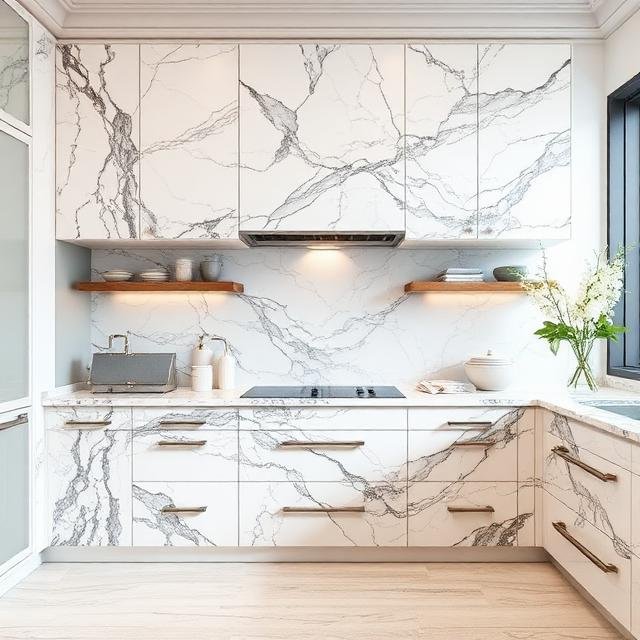
2. Functional Pragmatism: Dividing the Workload
Beyond aesthetics, this pairing is an engineer’s dream for real-world culinary performance. Natural marble is a metamorphic rock composed of calcium carbonate and it is porous and highly reactive to acidic liquids like lemon juice, wine, and vinegar. Placing marble solely on the island confines it to a controlled zone:
- The Island as the Entertaining & Prep Sanctuary: The island is where charcuterie boards are presented, pastries on naturally cool stone, and guests gather with drinks. It experiences less contact with high-temperature sautéing and grease splatter.
- The Perimeter as the Heavy Culinary Workhorse: The perimeter houses the range, cooktop, ovens, and primary cleanup zones. Granite is an igneous rock formed under immense heat and pressure and virtually impervious to thermal shock, knife scratches, and acidic etching. Placing dark granite here allows cooks to work without anxiety.
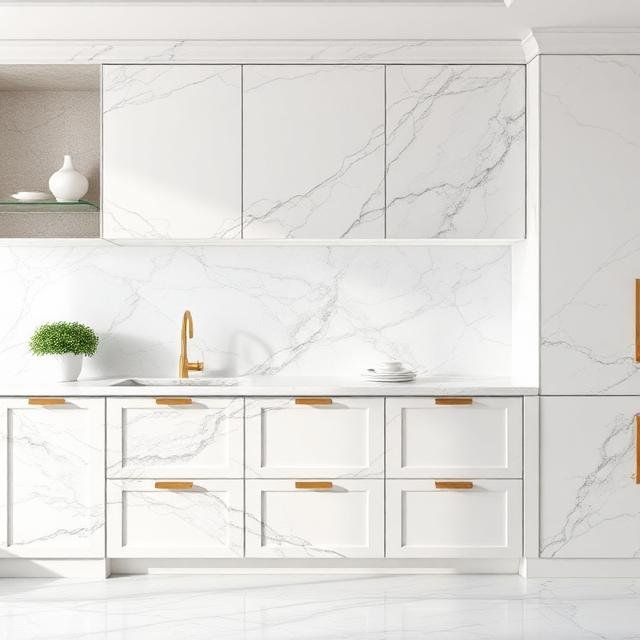
3. Matching Tone, Veining, and Stone Selection
To achieve visual harmony rather than visual confusion, specific stone pairings must be thoughtfully curated:
| Marble Island Selection | Recommended Dark Granite | Visual Mood & Aesthetic Style |
| Calacatta Gold / Lincoln (Warm white base, golden caramel & grey veining) | Virginia Mist (Honed) (Deep charcoal with soft, cloud-like white dusting) | Warm Transitional, Modern Farmhouse, Organic Luxury |
| Statuario / Arabescato (Cool white field with bold, dramatic charcoal ribbons) | Nero Assoluto / Absolute Black (Pure pitch-black, consistent fine grain) | High-Contrast Contemporary, Urban Minimalist |
| Carrara (Bianco) (Soft feathery grey veining, muted misty ground) | Steel Grey or Impala Black (Graphite-hued, crystalline medium texture) | Classic Parisian Bistro, Timeless Traditional |
| Verde Alpi / Green Calacatta (Forest green tones with white and jade currents) | Black Beauty / Cambrian Leathered (Rich matte black with subtle tactile dimpling) | Moody Heritage, English Country Manor |
4. Surface Finish Harmony: Honed vs. Leathered vs. Polished
One common misstep is clashing textural finishes. A high-gloss polished Absolute Black perimeter paired with a soft honed marble can feel disjointed because the reflective qualities tell two completely different stories under ambient lighting.
- The Unbeatable Pair: Honed Marble + Leathered/Suede Granite. A honed marble island (satin, non-reflective) feels tactile and organic, softening the visibility of future micro-etches. Pairing this with a leathered dark granite perimeter adds subtle undulation, completely eliminating reflective glare under-cabinet lighting while concealing daily fingerprints.
- The Tailored Contemporary: Honed Marble + Honed Granite. This delivers a consistent, velvety matte presence across all planes, exuding quiet architectural luxury.
- Avoid: Ultra-glossy polished granite with heavy specks such as like Baltic Brown paired with delicate matte marble; the visual clash will date the kitchen instantly.
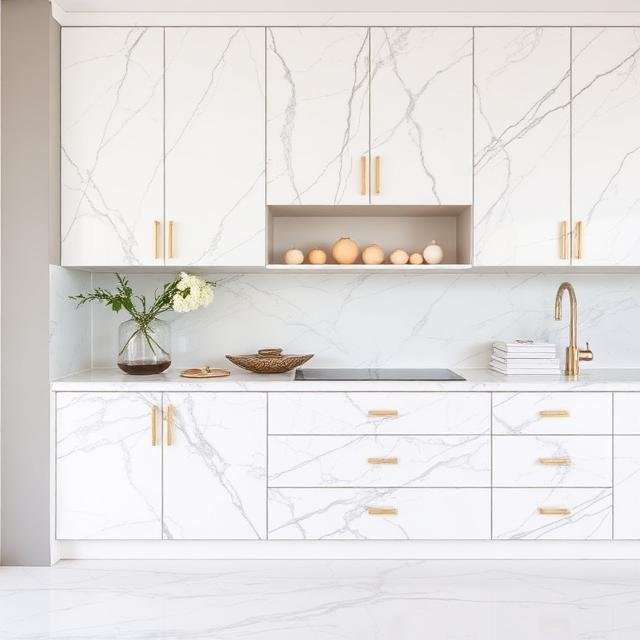
5. Cabinetry, Backsplash, and Hardware Bridge
When working with two contrasting counter materials, the surrounding architectural envelope must bridge the two stones together:
- Cabinetry Palette: Two primary approaches exist. Monochromatic Cabinetry allows the countertops to act as the primary contrast. Alternatively, Tuxedo Cabinetry pairs a rich stained white oak or charcoal island base with warm off-white perimeter cabinets, creating a balanced inverted rhythm.
- The Backsplash Strategy: Never introduce a third competing stone tile. Instead, run the dark perimeter granite 4 to 8 inches up as a continuous lip, or carry a neutral handmade Zellige tile, glazed ceramic subway finish up to the ceiling. If budget permits, running the perimeter granite as a full-height slab backsplash behind the stove creates a stunning, monolithic cooking alcove.
- Hardware & Fixtures: The brass, burnished bronze, or matte black fixtures gives a unifying metallic through-line that flatters both warm marble veins and deep black granite.
6. Conclusion
Pairing a marble island with dark granite perimeters is not a fleeting micro-trend; it is an enduring architectural solution that honors both artistic desire and day-to-day culinary reality. By allowing marble to shine as an expressive work of natural art in the center while delegating the perimeter to virtually indestructible dark granite, you craft a kitchen that matures gracefully, balances light and shadow, and offers the best of both geological worlds.
Frequently Asked Questions (FAQs)
Q: Won’t mixing two different stone materials make my kitchen look mismatched or unfinished?
Not if you follow intentional focal hierarchy. A mismatch occurs when both stones compete for attention with high-contrast, loud patterns. When you select one dramatic hero stone (the veined marble) and one subdued anchor stone (a quiet, uniform dark granite), the pairing looks deeply intentional and curated.
Q: Does dark granite require sealing just like marble?
Dense dark granites like Absolute Black and Nero Assoluto have exceptionally low porosity and often require minimal to no sealing—in fact, applying standard sealers to ultra-dense black granite can cause a hazy residue. However, softer stones like Virginia Mist or leathered varieties should be sealed annually to prevent oil darkening. The marble island will require diligent bi-annual impregnating sealers and pH-neutral cleaners.
Q: Should the edge profile match between the island and perimeter?
Generally, yes. Keeping the edge profile consistent (such as a 1/8″ eased edge or slight pencil bevel) maintains architectural continuity. However, you can vary the slab thickness: a beefier 2″ mitered apron on the marble island adds dramatic heft, while a standard 1.25″ (3cm) profile on the perimeter keeps things sleek and practical.
Q: Can I use dark soapstone or quartz instead of dark granite?
Yes. Soapstone provides a similar deep charcoal tone with silky warmth, though it scratches more easily than granite and patinas over time. Honed black quartz offers low maintenance, but granite remains superior in heat resistance and depth of natural mineral composition.

