
It is located in the Ajmer district of Rajasthan, India. Kishangarh marble market is globally renowned as the Marble City of Asia. Holding the title of Asia’s largest single market for granite, marble, and natural stone, a vast industrial zone houses thousands of processing showrooms.
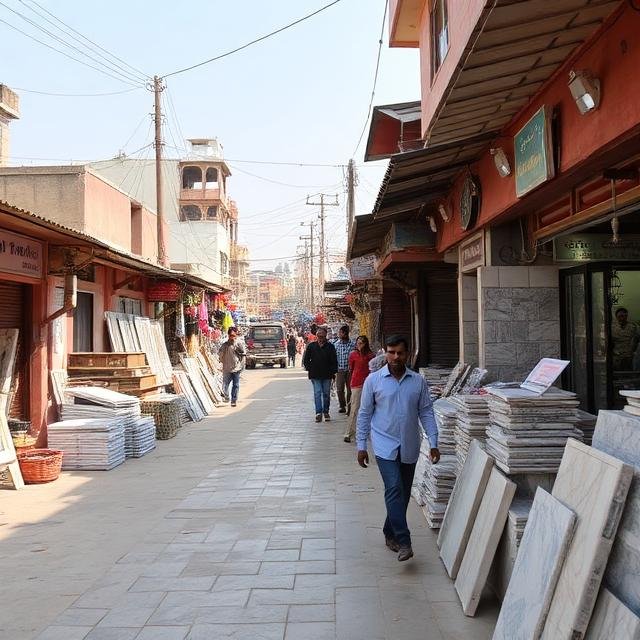
For interior designers, builders and individual homeowners offer an unparalleled selection of indigenous and imported stones. However, the scale of the market can be deeply overwhelming. This vast trade hub successfully requires technical understanding and sharp transactional awareness.
The Scale and Scope of the Market
Kishangarh does not merely trade local stone; it serves as a central global processing hub, and it is located in close proximity to major domestic quarry sites in Rajasthan, yielding legendary stone like Agaria and Rajnagar, and it is also the premier destination for premium stone. Raw stone blocks arrive at Kishangarh from Italy, Turkey, Vietnam, and Brazil to be processed, polished, and sold.
The market is divided into sprawling sectors, primarily grouped around the Madanganj industrial zone and the National Highway. Stockyards here frequently span multiple acres, holding thousands of slabs in varieties to ensure the commercial-scale matching is easily achievable.
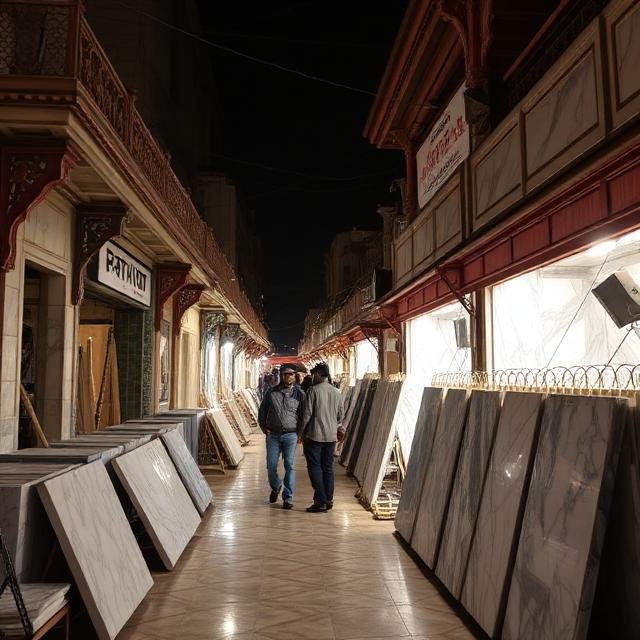
Material Taxonomy: What is Available?
Before stepping into the showroom, you need to understand the primary classification of stone in Kishangarh serves distinct textural, color, and structural purposes:
- Indian Marble: Highly durable and stable to chemical reactions. It is nonporous. Indian marble is excellent for any high-footfall flooring, staircases, and outdoor applications. It is notable for varieties that include Makrana marble, Agaria white, and Rajnagar marble and is widely used for residential flooring due to its soft textures and budget-friendliness.
- Imported (Italian) Marble: Prized for its brilliant gloss, bold veins, and high aesthetic prestige. Imported marble is typically softer and requires a protective epoxy resin backing layer. Its popular options include Calacatta and Statuario backgrounds with dramatic gray veins that command the highest premium and Michelangelo and Grey William suits for contemporary minimalist design.
- Granite and Quartzite: In addition to the marble, Kishangarh has processed monumental volumes of Indian and imported granite along with the exotic quartzites. These materials offer extreme scratches and hardness. It is perfect for kitchen countertops and accent walls and external cladding.
Critical Inspection and Quality Checks
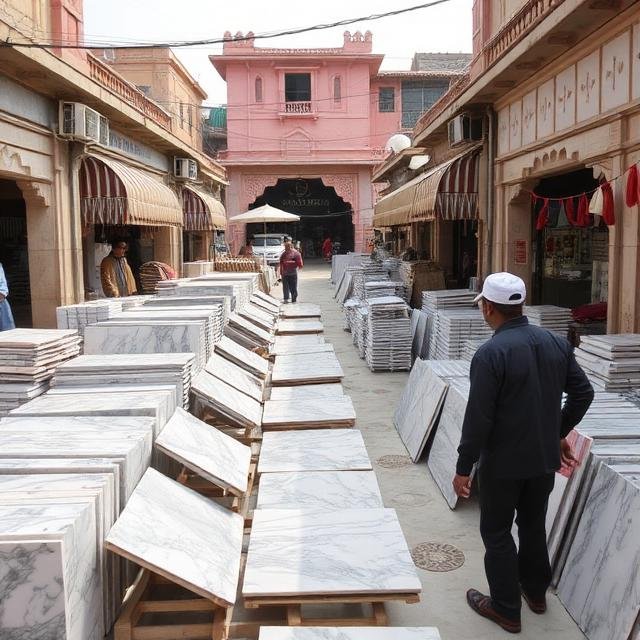
The single biggest mistake a buyer usually makes in Kishangarh is purchasing a lot based entirely on a pristine display sample. The natural stone has inherent geological variations, cracks, and fissures. Implement the verifications protocol in the stockyard:
- Insist on Water Splashing: Slabs look drastically different dry versus polished/wet. Splash water over the unpolished edge or raw slab surface to reveal the true depth of color and veining clarity and to uncover hidden cracks.
- Check for Fissures and Artificial Filling: Look closely at the slab under direct sunlight. Check if structural cracks have been heavily masked with colored epoxy resins. While epoxy treatment is standard for imported stones, excessive structural fillings compromise structural integrity.
- Measure Uniform Thickness: Standard slabs should be cut consistently at 16 mm, 18 mm, or 20 mm. Use a digital vernier caliper to check multiple points on a slab. Variation in thickness leads to severe installation difficulties and excessive wastage.
- Examine the “Lot” Alignment: Ensure you buy slabs from the exact same block (serial numbering is typically painted on the sides). Mixing blocks will result in mismatched veining patterns on your floor.
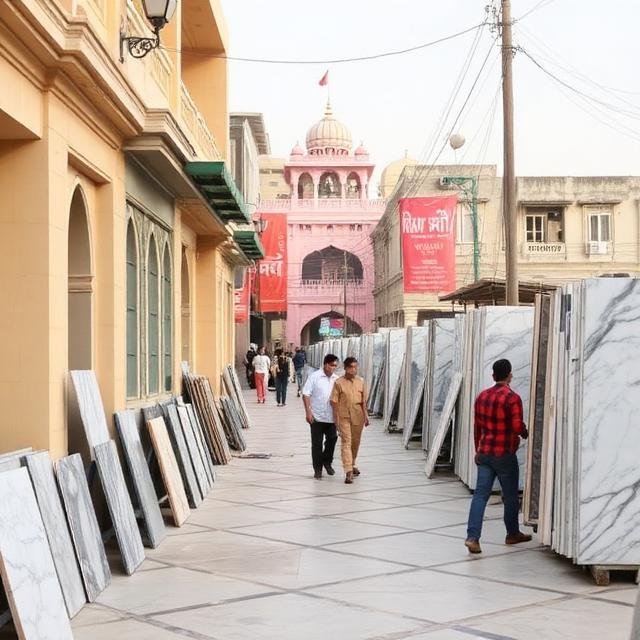
Cost Dynamics and Hidden Charges
The quote that you receive per square foot from any seller is rarely the final cost that lands at your destination. In order to keep track of your budget, map out the cost breakdown beforehand.
- Base Material Cost: The per-square-foot price for basic Indian stone is approximately Rs 1,000 per sq ft.
- Measurement Custom: Sellers usually measure the total outer dimensions of the slab and negotiate to deduct the broken and heavily tapered corners.
- Loading & Transit Insurance: Charges for crating and loading onto commercial vehicles. The transit insurance is highly recommended.
- Interstate Freight & Tolls: Calculate per metric ton to your specific delivery city.
- Wastage Allowance: The additional factor of 15% to 20% over the architectural area for cutting and pattern matching.
Conclusion
Sourcing natural stone from the Kishangarh market provides unmatched financial benefits, a diverse collection, and access to a unique variety of stones and high-end materials. However, turning these advantages to your favor requires a sharp eye, deliberate patience, and precise calculations. By understanding the stone varieties and enforcing strict stockyard inspections. You can confidently secure the beautiful, long-lasting natural surfaces for your architectural projects.
Frequently Asked Questions (FAQs)
- Q1: Which is better for residential flooring: Indian marble or imported Italian marble?
- A: Indian marble is significantly harder, more durable, more resistant to stains, and requires less maintenance, making it highly practical for high-traffic areas. Imported Italian marble offers unparalleled premium gloss, soft pastel hues, and dramatic veining patterns but is softer and more prone to staining, making it ideal for low-traffic drawing rooms, vanity counters, and accent walls.
- Q2: Why is there a huge price variation for the same marble type across different vendors?
- A: Marble prices are dictated by the purity of the slab background, sharpness of veining, lack of structural defects, and the total size of the uniform block lot. A massive, faultless lot with a bright white background will command a steep premium compared to smaller, fractured, or grey-tinted lots of the same variety.
- A: Marble prices are dictated by the purity of the slab background, sharpness of veining, lack of structural defects, and the total size of the uniform block lot. A massive, faultless lot with a bright white background will command a steep premium compared to smaller, fractured, or grey-tinted lots of the same variety.
- Q3: How do I ensure that the marble I selected isn’t swapped during loading?
- A: When finalizing a lot, use an indelible marker or paint to place your signature, initials, or a custom stamp across the raw edges of the stacked slabs. Document the stamped block numbers with high-resolution photography and verify them comprehensively during the loading process.
- A: When finalizing a lot, use an indelible marker or paint to place your signature, initials, or a custom stamp across the raw edges of the stacked slabs. Document the stamped block numbers with high-resolution photography and verify them comprehensively during the loading process.
- Q4: Is bargaining acceptable in the Kishangarh market?
A: Yes, bargaining is standard. Initial quotes are typically marked up by 15% to 25%. Price adjustments become significantly more flexible if you purchase large volumes (entire truckloads) or clear out whole block lots from a vendor.

