
Outdoor living spaces have transformed from simple patio grill stations into sophisticated culinary destinations. When investing thousands of dollars into alfresco cabinetry, built-in grills, pizza ovens, and refrigeration, surface selection becomes your kitchen’s first line of defense.
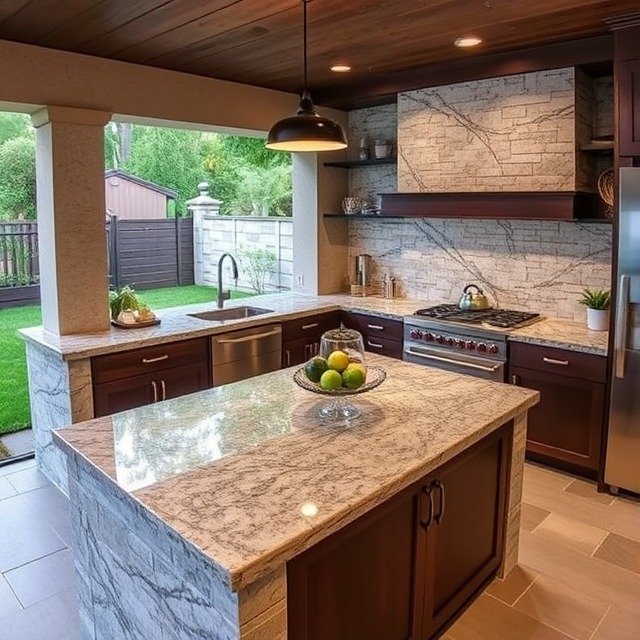
Among the trio of luxury countertop contenders, such as granite, marble, and quartz, homeowners frequently ask, “Which stone actually survives the elements?”
While quartz dominates indoor renovations and marble evokes timeless European elegance, natural granite stands as the undisputed champion for outdoor installations. Below, we break down the geological, functional, and aesthetic reasons granite slabs consistently beat out marble and engineered quartz in open-air kitchens.
The Harsh Reality of Outdoor Kitchen Environments
Indoor countertops enjoy climate-controlled stability. Outdoor countertops, by contrast, must endure severe stressors:
- Intense UV Radiation: Solar exposure degrades artificial polymers and fades organic pigments.
- Extreme Thermal Shock: Slabs endure direct contact with cast-iron cookware, smoker lids, and searing summer heat followed by sub-zero winter freezes.
- Biological Staining: Bird droppings, fallen leaves, pollen, red wine, and acidic barbecue marinades sit on surfaces longer than indoors.
- Moisture Intrusion: Rain, snow, and freeze-thaw cycles can cause microscopic fissures to expand and split brittle materials.
To thrive in these conditions, a surface must be chemically stable, heat-impervious, and structurally dense.
The Showdown: Granite vs. Quartz vs. Marble
| Performance Metric | Natural Granite | Engineered Quartz | Natural Marble |
| UV Resistance | 100% UV-stable; will not yellow or warp | Resin binders degrade, yellow, and warp. | Naturally UV-stable, but subject to surface chalking |
| Heat Resistance | Forged in magma; withstands 1,200°F+ | Polymer resins scorch/discolor at ~300°F. | Moderate heat resistance; prone to thermal shock |
| Acid & Etch Resistance | Highly resistant to citric acids, vinegar, and sauces | High chemical resistance | Extremely vulnerable to etching from citrus, wine, and tomato |
| Scratch Resistance | 6 to 7 on the Mohs Hardness Scale | ~7 on the Mohs Scale | 3 to 4 on the Mohs Scale (easily scratched by utensils) |
| Maintenance Outdoors | Annual penetrating sealer application | Voided outdoor warranty; irreversible discoloration | Frequent sealing is required; patina/etching is inevitable. |
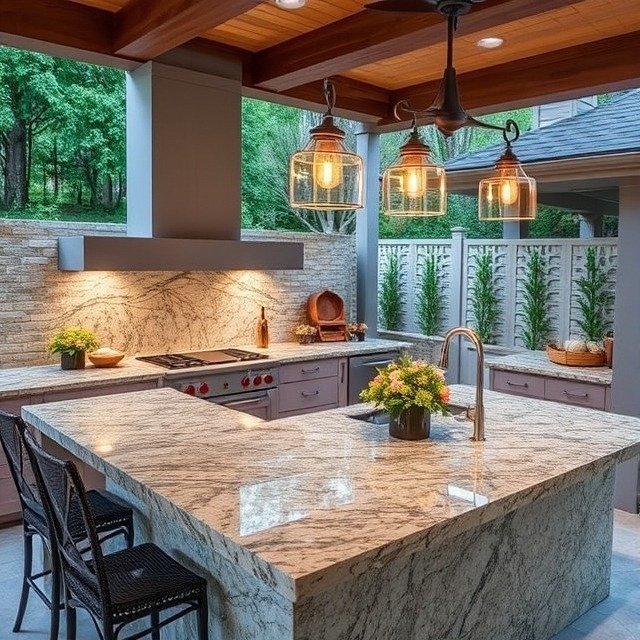
1. Why Granite Beats Quartz Outdoors
Engineered quartz is often billed as “maintenance-free” indoors, leading many homeowners to assume it will excel outside. In reality, quartz is one of the worst choices for open-air spaces.
- Polymer Resin Degradation: Engineered quartz is roughly 90–93% crushed mineral bound together by 7–10% petroleum-based polyester resins and pigments. Under constant ultraviolet (UV) radiation, these resins undergo photo-oxidation. The result is noticeable yellowing, cloudy blotches, and surface chalking.
- Thermal Shock and Scorching: Because quartz relies on resins, putting a hot cast-iron skillet directly from a 700°F grill onto a quartz countertop can cause thermal cracking or indelible white heat rings.
- Warranty Voidance: The vast majority of quartz manufacturers explicitly void their warranties if the slab is installed outdoors or exposed to direct sunlight.
- The Granite Advantage: Granite is an igneous rock formed deep within the earth’s crust under unfathomable pressure and heat. It contains zero synthetic resins or adhesives. The sun cannot alter its mineral composition, nor can a hot grill griddle scorch its crystalline structure.
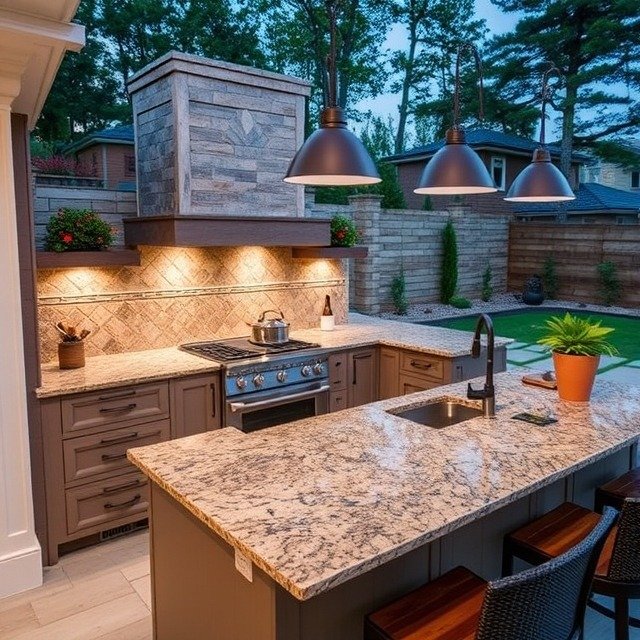
2. Why Granite Beats Marble Outdoors
Marble delivers romantic, soft-veined luxury, but it is geologically unsuited for the messy, high-acid demands of outdoor cooking.
- Severe Acid Vulnerability (Etching): Marble is primarily composed of calcium carbonate (CaCO₃). Common barbecue staples—lemon juice, balsamic glazes, ketchup, beer, and tomato sauce—react chemically on contact, dissolving the surface calcium and leaving dull, rough spots known as acid etches. Even a high-grade sealer cannot prevent chemical etching.
- Softness and Scratching: Scoring only 3 to 4 on the Mohs Hardness scale, marble scratches under basic grill tools, abrasive cutting boards, and outdoor debris like windblown sand.
- Moisture and Freeze-Thaw Cracking: Marble is softer and often more micro-porous than dense granites. Water trapped within unsealed marble expands when freezing, causing micro-fractures that eventually split the slab along natural calcite veins.
- The Granite Advantage: Granite is packed with quartz and feldspar, making it nearly twice as hard as marble. It resists scratching from stainless steel tongs, cleavers, and iron cookware, while resisting acid attacks from citrus marinades and vinegars.
Design Flexibility: Finishes That Enhance Outdoor Granite
While polished granite is standard indoors, outdoor kitchens offer opportunities for tactile, low-glare finishes:
- Honed (Matte) Finish: Delivers a smooth, satin-like look without harsh mirror reflections under midday sunlight.
- Leathered (Brushed) Finish: Texturizes the surface, subtly closing the stone’s pores while disguising outdoor dust, water spots, and fingerprints.
- Flamed Finish: Created by applying a high-temperature torch to the slab face until crystals pop, leaving a rugged, rustic texture that prevents slipping and withstands rugged weather effortlessly.
Essential Maintenance Tips for Outdoor Granite
While granite is exceptionally durable, basic preventative maintenance ensures it lasts decades:
- Choose the Right Color: Darker granites (e.g., Absolute Black, Uba Tuba) can become scorching hot to the touch in direct summer sun. Medium-toned earth granites, grays, and tans reflect heat better and mask airborne pollen and dust.
- Apply a High-Quality Solvent-Based Impregnating Sealer: Seal your outdoor granite once every 12 to 18 months. Water should bead cleanly on the surface.
- Avoid Harsh Chemicals: Clean with warm water and mild dish soap or a dedicated stone cleaner. Steer clear of bleach or ammonia, which prematurely strip the protective sealer.
Conclusion
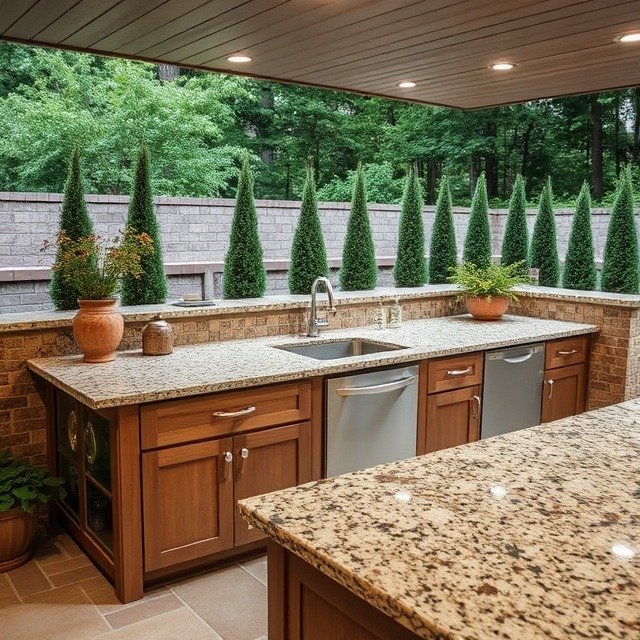
Your outdoor kitchen is an investment designed to withstand wind, rain, searing grease, and roasting summer sun. While engineered quartz fades and melts under UV exposure, and marble falls victim to scratches and citric acid burns, granite slab countertops endure undamaged. By pairing natural igneous stone with your outdoor layout, you secure a timeless, weather-proof, heat-impervious workspace that looks just as striking in its tenth year as it did on day one.
Frequently Asked Questions (FAQs)
Q1: Does granite need to be covered during the winter?
While granite naturally handles sub-zero temperatures, covering your outdoor kitchen with breathable waterproof covers is recommended. This prevents freeze-thaw stress from standing meltwater in the seams and keeps falling debris or ice from impacting edges.
Q2: Will dark granite get too hot to use in direct sunlight?
Yes. Deep black or dark charcoal granite absorbs ambient thermal energy quickly and can reach temperatures uncomfortable to lean against or touch. If your patio lacks a pergola, pavilion, or shade umbrella, opt for lighter gray, beige, brown, or speckled white granites.
Q3: Can I cut food directly on an outdoor granite slab?
Technically, yes—granite is harder than steel knives. However, cutting directly on stone will dull your blades rapidly and can prematurely scratch or strip your penetrating stone sealer. Always use a dedicated cutting board.
Q4: How do I know if my outdoor granite needs resealing?
Perform the simple “Water Droplet Test”: Pour a few tablespoons of water onto the counter and wait 15 minutes. If the water beads tightly, your seal is intact. If the stone darkens under the puddle, moisture is penetrating, indicating it is time to apply a coat of penetrating outdoor sealer.
Q5: Can I use outdoor-rated quartz instead of granite?
A few brands produce UV-resistant outdoor quartz lines. While these resist yellowing better than standard indoor quartz, they still lack the natural high-heat threshold of granite and often carry steep price premiums compared to readily available natural stone slabs.

