
When designing a statement piece of interior design, there are few elements that give a visual drama look. A bookmatched marble or granite is the best option for creating a statement piece. Each adjacent slab is from the same block, and the opposite faces are polished to mirror each other, and that can transform the raw geological pattern into symmetrical works of art.
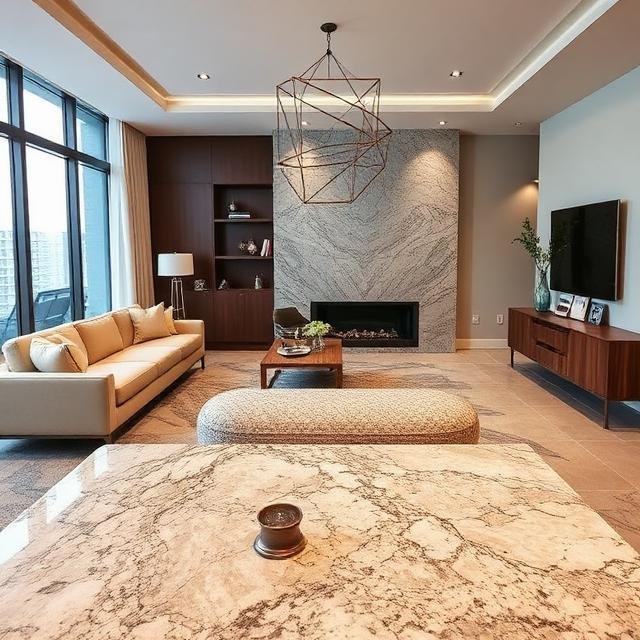
The marble has a historical background and is the best option for a bookmatched statement, as it is available in exotic colors and vein patterns, whereas granite is also available in a wide collection. Choosing between bookmatched marble and granite needs a proper understanding of structural requirements, maintenance, budget, aesthetic drama, and lighting of the space.
Quick Comparison
| Feature / Criteria | Bookmatched Marble | Bookmatched Granite |
| Aesthetic Character | Flowing, continuous ribbons; classical elegance | Dynamic, granular, high-contrast, crystalline |
| Popular Varieties | Calacatta, Statuario, Nero Marquina, Panda White | Black Taurus, Blue Bahia, Titanium, Copacabana |
| Light & Translucency | Soft subsurface glow; select varieties backlit easily | High surface gloss; opaque (translucency rare) |
| Vein Alignment Precision | Exceptional (linear & continuous flow) | Moderate to high (complex, multi-directional) |
| Scratch & Impact Resistance | Moderate (Mohs Hardness: 3–4) | High (Mohs Hardness: 6–7) |
| Maintenance Level | Moderate (periodic sealing; sensitive to acids) | Low to Moderate (durable, stain-resistant) |
| Best-Fit Applications | Living room accent walls, fireplace surrounds, master suites | Wet areas, commercial lobbies, high-traffic zones |
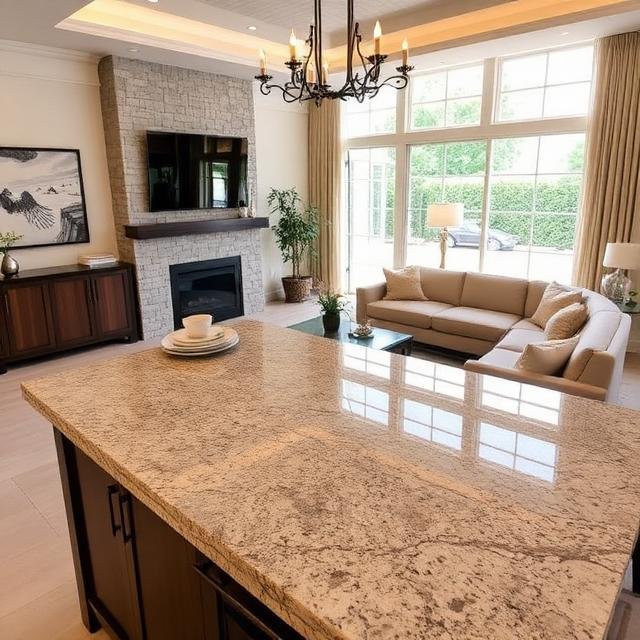
1. Aesthetic Impact & Vein Dynamics
Bookmatched Marble: Fluid Geometry and Timeless Luxury
Marble is composed of metamorphic limestone, and it has soft, flowing veins that give a balanced organic visual effect.
- Symmetry Precision: Since marble veining usually follows different layers of sediment, like in Statuario or Calacatta Gold, it creates a clean, almost seamless appearance at the seams.
- Visual Atmosphere: Marble has a soft color, luminous effect, and refined surface. Ideal for minimalist, contemporary luxury, and neoclassical interiors.
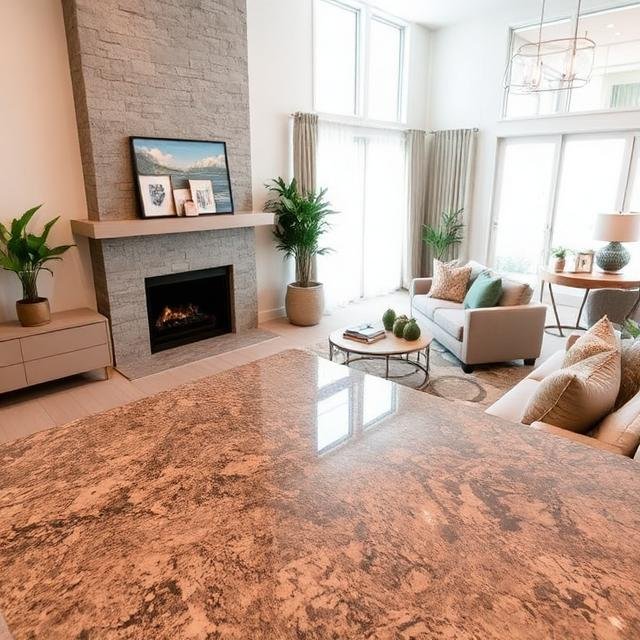
Bookmatched Granite: Bold Contrast and Crystalline Depth
Modern bookmatched granite depends on igneous “exotics” rich in feldspar, quartz, and mica elements.
- Symmetry Precision: Granites like Copacabana, Black Taurus, or Juparana have chaotic, swirling patterns. When it is mirrored, they form energetic, abstract focal points resembling butterfly wings.
- Visual Atmosphere: It is available in high-contrast, striking, and dramatic. It is perfect for moody luxury, maximalist spaces, and bold industrial architecture.
2. Lighting, Finish, and Translucency
- Marble’s Subsurface Glow: Marble shows slight translucency and allows ambient light to penetrate the surface slightly before reflecting back. When polished, it produces a deep, milky luster. Honed finishes on marble have softened the symmetry for understated, matte elegance.
- Granite’s Reflective Brilliance: Granite is composed of quartz and mica flakes that sparkle under direct accent lighting. While most granites are opaque, bookmatched slabs polished to a high sheen deliver mirror-like reflection and high dynamic range.
3. Durability, Weight, and Structural Considerations
- Weight & Wall Reinforcement: Both materials average 13–18 lbs per square foot at 2 cm (¾”) thickness and 18–25 lbs per square foot at 3 cm (1¼”) thickness. Ensure masonry anchoring, or epoxy-bonded mechanical anchors are engineered into the wall substrate.
- Thermal Exposure (Fireplaces): Both stones perform well on fireplace surrounds, but granite handles direct radiant heat without thermal shock risks. Marble requires a thermal barrier if exposed to direct open flame.
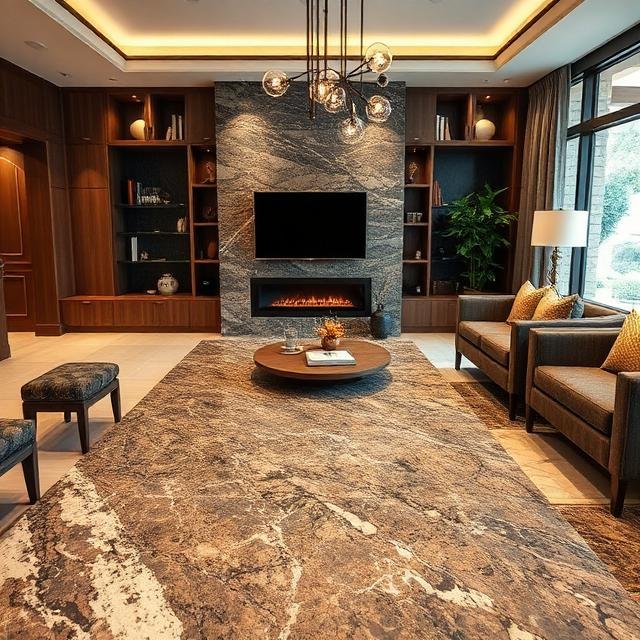
4. Cost and Sourcing Realities
- Consecutive Slab Sourcing: True bookmatching requires adjacent slabs cut sequentially from the same quarry block (Slabs A & B).
- Material Wastage: Achieving perfect alignment across multi-slab layouts (2-way or 4-way diamond matches) often results in 15%–30% material cut-off.
Which Should You Choose?
- Choose Bookmatched Marble if:
- You desire clean, flowing lines, linear ribbon symmetry, or classical luxury.
- The wall is located in a controlled environment (living room, executive lounge, master bedroom).
- You prefer soft veining with muted, warm, or crisp white undertones.
- Choose Bookmatched Granite if:
- You want bold, high-contrast, dramatic patterns with metallic or crystalline flecks.
- The feature wall is in a high-traffic or moisture-prone area (bathroom wet wall, patio enclosure, lobby).
- You want maximum scratch resistance and minimal sealing frequency.
Frequently Asked Questions (FAQs)
Q1: What is the difference between a 2-slab and a 4-slab bookmatch?
A 2-slab bookmatch pairs two consecutive slabs horizontally or vertically, creating a single mirror axis (butterfly match). A 4-slab bookmatch (diamond match) uses four sequential slabs mirrored across both vertical and horizontal axes, creating an intricate geometric diamond at the center.
Q2: Can any marble or granite slab be bookmatched?
No. Slabs must be quarried consecutively from the same block and polished on alternating faces (one face-polished, the next back-polished). Slabs with irregular, non-directional grain or solid colors do not produce noticeable bookmatched symmetry.
Q3: How do you hide the seam in a bookmatched stone wall?
Fabricators use color-matched polyester or epoxy resins mixed with stone dust, ground flush and polished on-site to make seams virtually imperceptible.
Q4: Is granite cheaper than marble for feature walls?
Standard granites are cheaper, but exotic granites required for bookmatching (such as Blue Bahia or Titanium) often command prices comparable to mid-to-high tier marbles.

