Imported marble is the symbol of luxury. There are varieties of imported marble like Carrara, Calacatta, and Statuario marble. Imported marble has unique veins with luminous quality. However, high demand for premium imported marble has led to a proliferation of fake stones in the market, including engineered stone, low-grade marble, and porcelain.
In this article, let us know how to distinguish the genuine imported marble from imitation marble and protect your investment, ensuring the durability of your project.
The Key Characteristics of Genuine Imported Marble
The imported marble possesses a set of unique features and aesthetic traits formed over millions of years under high pressure and heat by natural processes.
| Characteristic | Genuine Imported Marble | Fake/Low-Quality Marble |
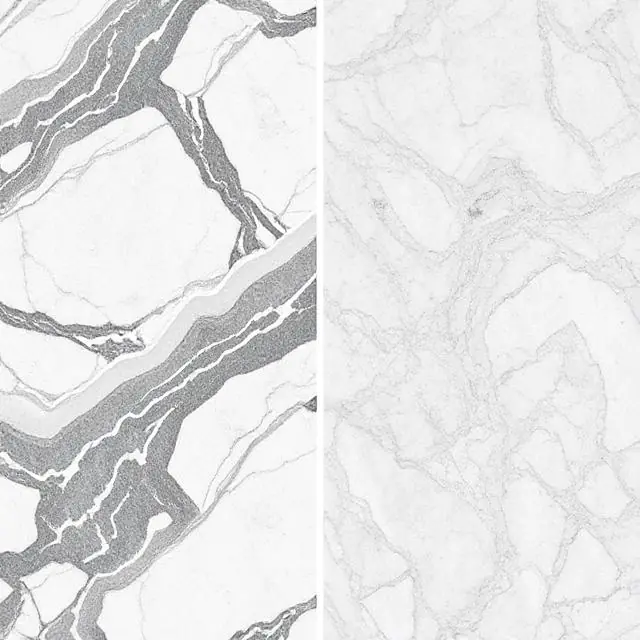
| Veining & Pattern | Irregular, Organic, and Unique. Veins flow seamlessly, show depth, and never repeat exactly from one slab to the next. | Repetitive, Symmetrical, or Printed. Patterns often look flat, uniform, or pixelated. |
| Touch Test | Cool to the Touch. Natural stone has high thermal conductivity, making it feel distinctly cool, even in warm weather. | Warmer to the Touch. Engineered stone or ceramic holds heat more easily and can feel less dense or plastic-like. |
| Translucency (Glow) | Slightly Translucent. When a strong light is shined on a thin piece, the light should pass through, giving it a soft, luminous glow. | Opaque. Light will not pass through; the surface simply reflects it back. |
| Density & Weight | Heavy and Solid. Marble is a dense metamorphic rock. Genuine slabs will feel significantly heavier and more substantial than synthetic alternatives. | Lighter. Engineered or ceramic slabs often feel lighter due to their composite or hollow structure. |
| Underside | Natural and Continuous. The veining and pattern should be visible or consistent throughout the thickness of the stone, even on the raw edge. | Uniform/Artificial Core. May show a printed top layer with a plain, uniform underside, or a mesh/resin patch for reinforcement on a low-quality stone. |
Simple Tests to Perform Before You Buy
During the visual inspection of marble, it is essential to follow up with some tests to confirm the authenticity.
- Water Absorption Test: Put a few drops of water on the unpolished marble or the sample provided.
- Genuine Marble: It takes time to absorb the water, and it slightly absorbs water due to its natural porosity.
- Fake/Glazed Stone: In this the water droplets will not absorb; instead, they start to flow or bead up.
- Scratch Test (Use Caution): A little scratch on the surface of marble is the tip of a coin.
- Genuine Marble: These marbles have minor scratches on the surface of the marble.
- Engineered Stone/Porcelain: These are likely to resist scratching, and they are made up of hard materials, which indicates it is not a natural marble.
- Sound Test: Tap the slab with a knuckle or using a small metal object.
- Genuine Marble: It must produce a clear ringing or solid sound when it is tapped.
- Fake/Cracked Marble: It may produce a hollow or light sound when it is tapped.
How to Avoid Scams and Ensure Authenticity
The best defense against fakes is buying smart.
- Request Documentation: During inspection always ask for the certificate of origin. A reputable supplier always provides the certificate of origin.
- Inspect the Entire Slab: Do not rely on the samples; always look at the big slabs for inspection to assess the authenticity of marble veining, color pattern, and overall quality of marble.
- Beware of “Too Good to Be True.” Pricing: The high-grade marble is expensive due to the naturality of marble, the extraction process, the transportation cost, and the finishing. An unusually low price of marble is a clear signal of low-quality marble or fake marble.
- Consult a Professional: If you are not sure how to assess the authenticity of marble, then it is better to hire a professional, a stone expert, to inspect the marble slabs before finalizing the purchase.
Conclusion: Investing in Legacy
Genuine imported marble is a significant investment that brings incomparable beauty, value, and longevity to your home. While imitation products can fool the eye at first, they inevitably lack the unique character, depth, and cool density of natural stone. By being a vigilant, educated buyer—examining the vending, performing simple tests, and demanding proper certification—you can confidently select an authentic piece of geological art that will grace your space for generations.
Frequently Asked Questions (FAQs)
Q1: Is all imported marble the same quality?
A: No. Quality varies significantly by quarry and grade. Italian marbles like Statuario and Calacatta are generally considered high-end, while others from Turkey or Greece may have different properties regarding porosity and hardness. Always check for low porosity and even cutting.
Q2: What is “engineered marble,” and is it a good substitute?
A: Engineered marble is a composite material made from marble dust, resins, and pigments. While durable and non-porous, it lacks the unique, organic veining, cool temperature, and subtle translucency of natural marble. It is a good, low-maintenance alternative but is not genuine natural stone.
Q3: Can fake marble be identified by its shine?
A: A strong, natural, mirror-like polish is a sign of good quality, but an overly glossy, plastic-like shine can be a red flag. Some low-quality stones are heavily treated with resins to mask flaws and achieve an artificial-looking gloss that fades quickly.
Q4: Should real marble scratch easily?
A: Real marble is a soft stone, so it is more prone to minor surface scratching than harder stones like granite or engineered quartz. The scratch test is used to rule out extremely hard, man-made materials, not to test for scratch resistance.