
When choosing natural stone whether it is Italian marble like Carrara marble has dramatic veins pattern, black granite are the most demanding for homeowners and designers and they focus on exclusively on color and veins pattern. The finish of the stone dictates how the light bounces back on the surface and how it can withstand the acidic liquids on the daily use.
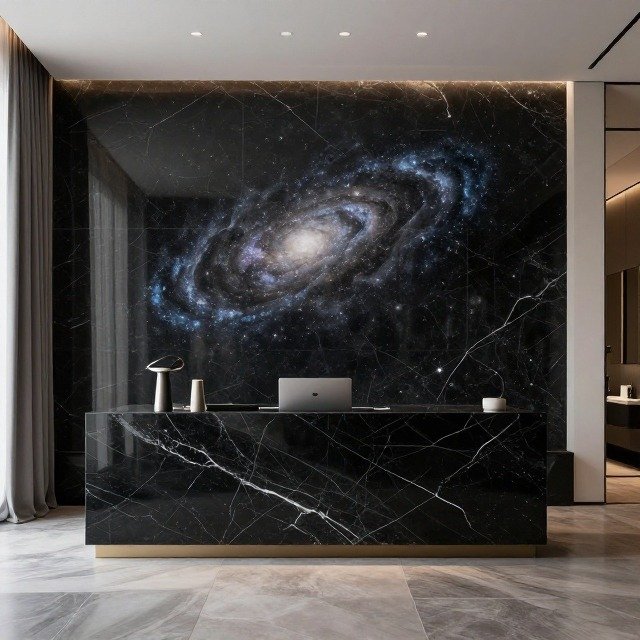
The same slab of stone can look moody and rustic, sleek and opulent, or architectural and sculptured depending purely on surface treatment.
Here is everything you need to know about the four most popular and transformative stone finishes: Honed, Leathered, Fluted, and Polished.
1. Polished Finish: The Timeless Classic
How It’s Created
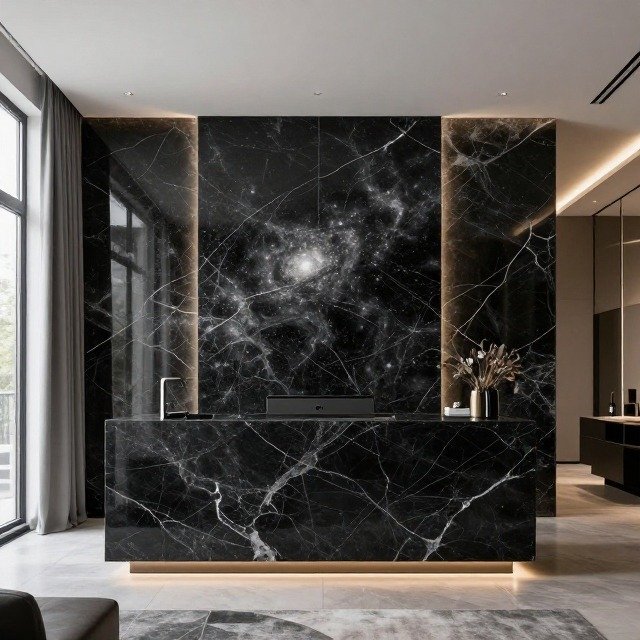
A polished finish is achieved through repeated mechanical grinding using diamond-grit abrasives after certain stage of processing the finer stages until the natural crystals of the stone refract light. No chemical glaze is added; the high-gloss mirror sheen is entirely mechanical.
Aesthetic & Tactile Profile
- Look: Glossy, vibrant, and mirror-reflective. Colors appear richer, blacks deeper, and veins sharper.
- Feel: Ultra-smooth, cool, and glass-like.
Best Used For
- Formal kitchen countertops and grand waterfall islands
- Bathroom vanity tops and wall cladding
- Powder rooms and fireplace mantels
- High-traffic commercial reception desks
Pros
- Enhanced Stain Resistance: Closing the microscopic surface pores makes polished stone inherently less porous and more resistant to liquid absorption than a honed finish.
- Vivid Colors: Accentuates the natural contrast and mineral flecks within granite and quartzite.
- Effortless Wiping: Spills and dust glide off smoothly with a microfiber cloth.
Cons
- Etch & Scratch Vulnerability: On calcitic stones, acidic etching from citrus, vinegar, or wine leaves dull spots that stand out starkly against the glossy background.
- Reflective Glare: Shows fingerprints, smudges, and water spots under direct task lighting or large windows.
- Slippery When Wet: Not recommended for shower floors or high-moisture floor applications.
2. Honed Finish: The Understated, Organic Look
How It’s Created
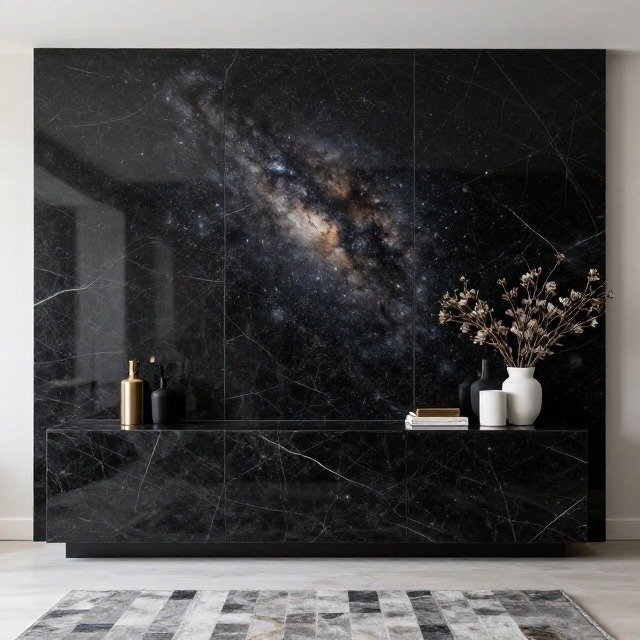
Honed stone is ground down using coarse-to-medium abrasives, stopping just short of creating a high-gloss reflection. The process yields a flat, matte-to-satin surface with little to no specular reflection.
Aesthetic & Tactile Profile
- Look: Matte, soft, contemporary, and velvety. Veining appears softer and colors take on an earthy, muted quality.
- Feel: Silky, chalky-smooth, and warm to the touch.
Best Used For
- Modern, transitional, Scandinavian, and European-inspired kitchens
- Bathroom flooring, walk-in showers, and wet rooms (due to better slip resistance)
- Patios, pool surrounds, and exterior cladding
- Low-glare spaces with dramatic, direct sunlight
Pros
- Hides Etching: When marble inevitably etches from lemon juice or wine, the resulting dull ring is almost invisible against a honed background.
- No Harsh Glare: Diffuses natural light beautifully without distracting reflections.
- Superior Slip Resistance: Safer underfoot than polished stone in moisture-prone zones.
Cons
- More Porous / Prone to Staining: The open microscopic pores absorb oils and colored liquids more readily; it requires diligent, high-grade penetrating sealer.
- Muted Coloration: High-contrast veining will look somewhat subdued compared to its polished counterpart.
3. Leathered (Suede) Finish: The Tactile Powerhouse
How It’s Created
To produce a leathered finish, the stone is first honed, then treated with heavy diamond-tipped brushes that run across the slab under high pressure. The bristles sweep away softer minerals while leaving harder minerals intact, producing a soft, undulating, organic texture.
Aesthetic & Tactile Profile
- Look: Deeply rich, semi-matte to low-sheen satin with dimensional micro-relief.
- Feel: Textured, pebble-like, and tactile—reminiscent of fine leather.
Best Used For
- High-use family kitchen islands and perimeter countertops
- Dark granites (e.g., Absolute Black, Steel Grey, Black Pearl)
- Outdoor kitchens and barbecue counters (masks pollen and weather dust)
- Rustic, modern farmhouse, industrial, or organic-modern interiors
Pros
- Conceals Imperfections: Virtually hides fingerprints, streaks, water droplets, and minor scratches.
- Retains Color Depth: Unlike honed finishes that can look chalky on dark stones, leathering preserves the deep, rich tonality of the slab.
- Tighter Surface: The brushing process actually tightens the surface pores compared to standard honing, providing improved stain resistance.
Cons
- Uneven Writing Surface: Doing paperwork or rolling delicate pastry dough on a heavily leathered slab can be awkward.
- Cleaning Grooves: Sticky spills require a soft-bristled brush or textured cloth to get into micro-depressions.
- Limited Availability: Works best on dense stones with varied mineral hardness (granite, quartzite); softer marbles may not take the treatment as effectively.
4. Fluted Finish: The Sculptural Showstopper
How It’s Created
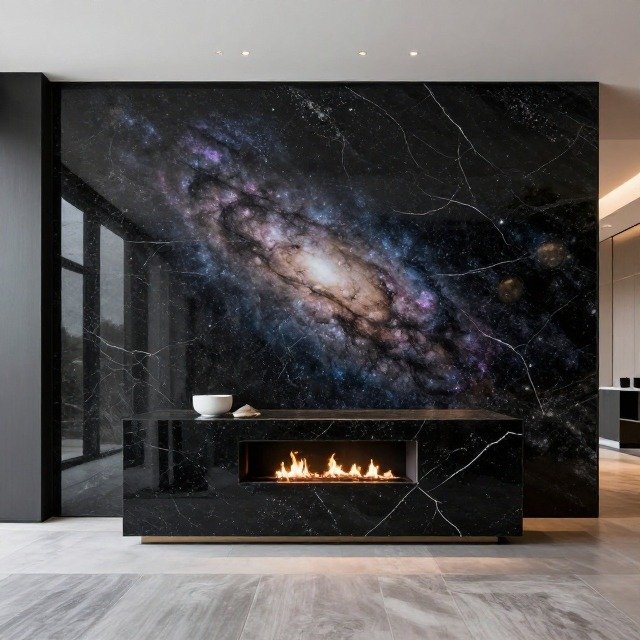
Fluting is a three-dimensional architectural finish produced using precision CNC waterjets or diamond milling tools. It carves repeating, concave (grooved) or convex (reeded) channels across the surface of the stone.
Aesthetic & Tactile Profile
- Look: High-relief, architectural, dynamic, and shadow-casting.
- Feel: Distinctly corrugated, rhythmic, and sculptural.
Best Used For
- Kitchen island kick faces and curved base wraps
- Full-height fireplace overmantels
- Powder room accent walls and custom integrated vessel sinks
- Backsplashes and shower feature walls
Pros
- Architectural Drama: Turns raw stone into an artisanal statement piece that catches changing daylight and shadow lines.
- Hides Seams: The linear grooves help mask vertical joints on curved installations and large expanses.
- Endless Customization: Can be milled with micro-reeding (tight, narrow ridges) or bold, deep flutes.
Cons
- High Maintenance: Not suited for horizontal work surfaces or cooking splatter zones—grease, flour, and sauce gather in the channels.
- Premium Cost: Milling requires specialized fabrication hours and precision equipment, significantly increasing production expenses.
- Fragile Edges: Outer ridges can be prone to chipping if bumped by heavy pots or hard furniture.
Stone Finish Comparison Cheat Sheet
| Feature | Polished | Honed | Leathered | Fluted |
| Sheen Level | High Gloss (80–90+ GU) | Matte / Satin (10–25 GU) | Soft Sheen / Low Satin | Varies (Matte/Honed grooves) |
| Texture | Mirror-smooth | Flat, velvety | Textured, undulating | 3D ribbed/grooved |
| Stain Resistance | High (naturally tight) | Moderate (open pores) | High to Very High | Depends on base stone |
| Etch Concealment | Poor (etches stand out) | Excellent | Very Good | Good |
| Fingerprint Resistance | Low | Moderate | Excellent | High |
| Best Horizontal Zone | Baker’s stations, bars | Bath vanities, floors | High-traffic kitchen tops | Not recommended for worktops |
| Best Vertical Zone | Sleek shower walls | Shower walls & floors | Fireplace surrounds | Accent walls, island wraps |
FAQs on Stone Finishes
Q1: Does a leathered finish cost more than a polished finish?
Yes. Polished is the industry standard for most imported slabs. Creating a leathered or honed finish usually incurs an additional fabrication or finishing charge (typically 10–25 per square foot), depending on whether the slab was purchased pre-finished from the quarry or custom-brushed at your local stone shop. Fluting is the most expensive due to extensive CNC machine runtime.
Q2: Can any stone be leathered?
Not all stones are ideal candidates. Dense, multi-mineral stones like granite, quartzite, and soapstone take exceptionally well to diamond brushing because the contrasting mineral hardness creates the signature texture. Softer, uniform limestones or pure white calcites can be brushed, but the effect will be more satin-smooth with less pronounced undulation.
Q3: What is the best finish to disguise water marks and fingerprints?
Leathered. The micro-textures diffuse direct light, making grease, oily handprints, and hard water scale virtually imperceptible. Honed finishes also perform well against fingerprints, but can show dark moisture rings temporarily until dried if not sealed thoroughly.
Q4: Can I change the finish of my stone after installation?
Yes, in most cases. A qualified stone restoration specialist can chemically hone down a polished marble countertop or buff a scratched surface on-site. However, leathering and fluting require industrial machinery and heavy water lubrication, meaning they generally cannot be applied once stone is permanently installed.
Q5: How often do these finishes need sealing?
- Honed: Every 6 to 12 months, as the open capillary structure absorbs liquids quickly.
- Polished: Every 1 to 2 years (or when water stops beading).
- Leathered: Every 1 to 2 years with a quality penetrating/impregnating sealer.
Conclusion
Choosing the right stone finish is not merely a technical specification; it defines the sensory soul of your room. If you crave sleek grandeur and maximum light bouncing across the ceiling, Polished remains the undisputed king. For European ease, subtle luxury, and effortless etch-camouflage, Honed is the modern designer’s go-to. If you run a bustling home and want indestructible, tactile warmth that defies fingerprints, choose Leathered. And when an accent surface demands sculptural intrigue and bespoke presence, let Fluted stone take center stage.

